

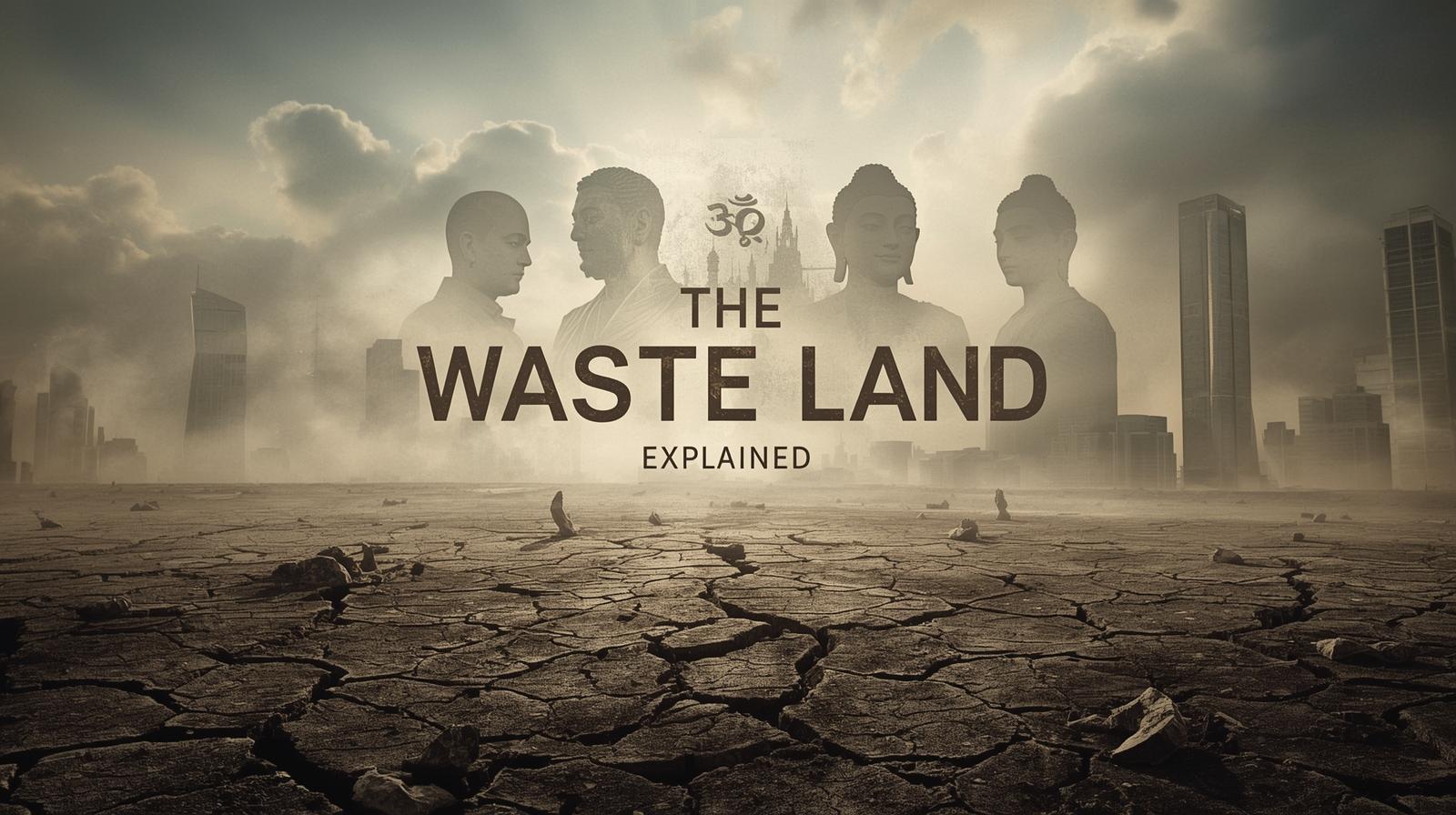
The Waste Land is an English poem written by T.S. Eliot. It was published in 1922. It is one of the important modern poems of the 20th century. It is a 433-line poem divided into 5 parts, and it was condensed with great care by the fellow poet Ezra Pound.
After the First World War, the world became a waste land after much destruction. The people of the world became disillusioned about many things of the world. Very often many people asked—what is the theme of The Waste Land? It is not a simple question. One critic, after much thinking, said—“The theme of The Waste Land are culture, sex, and religion.” Degradation in these three spheres is the theme of The Waste Land. Structure and language of the poem indicate these themes.
It is a complex poem. It has many literary allusions. It is a contrast between the past and contemporary barrenness in culture. He says in the opening lines—“April is the cruellest month.” In fact, April is the sweetest month, as narrated by Geoffrey Chaucer, the first modern English poet of the fourteenth century. But in the modern world the sweetest thing has become most bitter.
“There is not even silence
In the mountains
But dry sterile thunder
Without rain.”
T.S. Eliot draws our attention to many—Dante, Shakespeare, classical literature, mythology, the Bible, and the Upanishads. The reference is to the glory of the past. The modern city has become an unreal city. The degeneration in sexual life is depicted by the poet brilliantly. Man and woman have strained relations. The poet says—
“My nerves are bad tonight, yes bad, stay with me.
Why do you never speak, speak.
What are you thinking of? What thinking? What?
I never know what you are thinking. Think.
I think we are in rats’ alley
Where the dead men lost their bones.”
T.S. Eliot has said in Death by Water section that Phoenicians met their death in water. They had insignificant life. Here I do not agree with T.S. Eliot. Phoenicians’ life was not futile. They have contributed two things to our modern world—one is the use of money, which replaced the barter system. The second is English alphabets A to Z, which we are using today. We are indebted to the Phoenicians.
At last Eliot ends the poem with the optimistic Sanskrit refrain—Shantih, Shantih, Shantih. Eliot translated it in the footnote—“The peace which passeth understanding.” Eliot referred to Gautama Buddha also. The Waste Land is a modern poem where the present is jealous of the past.
(The views expressed are the writer’s own.)

Radhakanta Seth is a Former Income tax officer in Sambalpur. He is a Freelance writer and his articles have been published in some Oriya dailies like Sambad, Samaj, Dharitri and English dailies like The Telegraph and in a sociological journal ‘Folklore’ published from Kolkata.
(Photo has collected from net )