

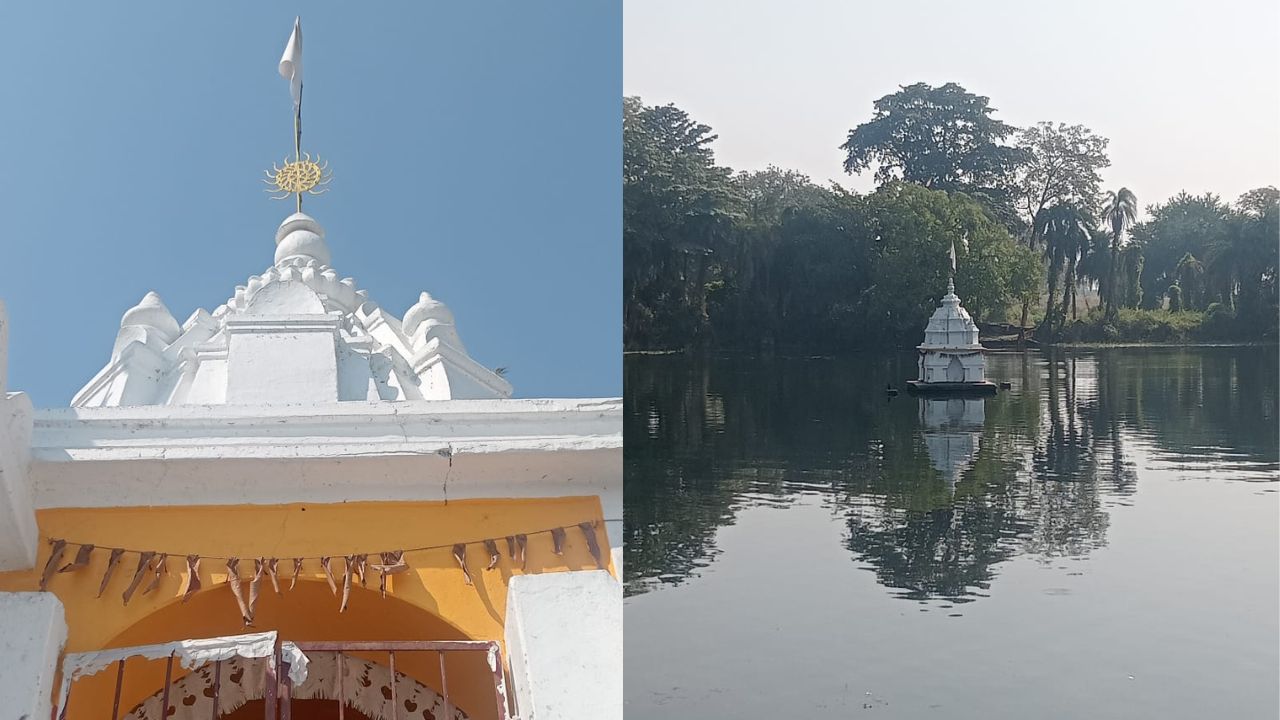
The other day I was passing by Mathpali, a village hardly six to seven kilometres from the city of Sambalpur. Suddenly I was reminded of Rani Math, which stands at the end of the village beside a large pond with a small temple. The location of the Math in a calm and quiet place, with the pond having been surrounded by trees, has always attracted me ever since my childhood days, and whenever I get the time I make it a point to visit it. Bhatra is the nearby village which, with its temple, Rathyatra and a long tradition of Ramleela by the village artists, has augmented the spiritual atmosphere in the area. Though the tradition of Ramleela has been wound up due to one reason or the other, Rathyatra still continues, thereby attracting people from nearby areas. In recent times, construction of Shankar Math, where Baba Swapneswar Mahadev gets worshipped, and another temple dedicated to Gandhiji have added to the popularity of the area.
This time I visited the Rani Math, had a Darshan of Ram, Luxman and Sita, the main idols, met the present Mahanta and priest, enjoyed the beauty of the pond and, last but not the least, refreshed my memory with the earlier visits as the gap between my last visit and the present one had widened too much.
The area around Mathpali was once full of jungles, and Guru Goswami Vasudev Das, the 10th and present Mahanta of the Math, takes its history to five hundred years back. But initially the Mahantas used to live in a cottage on the spot. The time referred to may be correct approximately, as the Chauhan dynasty of Sambalpur was founded by that time, and the Chauhan rulers, including Balaram Dev, the founder, not only encouraged all religious cults to flower in their kingdom but also extended patronage to saints and migration of people from other areas. In the course of time, the village which grew up near the Math has been named Mathpali. The present Mahanta makes it clear that the cottage was converted into a full-fledged Math with a temple approximately two hundred years back, and Guru Goswami Jairam Das, the eighth Mahanta, and Guru Goswami Shyam Das, the ninth Mahanta, completed the noble task. It was also during the time of the ninth Mahanta that the Gopaljee temple of Dhanupali was completed.
The Math is associated with the history of Sambalpur in another way. Rani Mohan Kumari Devi, who ascended the throne of Sambalpur in 1827 after the demise of her husband Maharaja Sai, used to visit the Math and offer Puja to Anantashajya Vishnu in the small temple inside the pond. Her brief rule, which continued till 1833, was marked by turmoil, unrest and discontent. She was the first-ever woman ruler of the Chauhan dynasty in Sambalpur, and conditions like the sudden death of her husband, the rise of Veer Surendra Sai against the British, discontent against her for being a woman, and the interference of the British in her affairs after the Marathas had quit must have compelled her to seek spiritual strength in visiting the Math and offering Puja to Anantashajya Vishnu, who is also believed to be a remover of obstacles. It is believed that the Math has been named after Rani Mohan Kumari Devi, also referred to as Rani Ratna Kumari. She was a brave lady who broke the tradition of rulership, faced the discontent against her and tackled the diplomacy of the British for quite some time and has therefore carved a place for herself in the history of Sambalpur.
The main temple in the Math and the temple in the middle of the pond are very simple and not very high in height. There is also not much of architecture in the two. Local temple style has been followed, with a Garvagriha and a Mandap in the main temple and only a Garvagriha in the pond temple. The temple in the middle of the pond seems to have been built much earlier than the temple in the Math, and its history may even date back to approximately five hundred years.
Since there are two temples, and in one Anantaji Mahaprabhu and in the other Ram, Luxman, Sita, Ladugopal, Luxmi Narayan, Radhakrishna, Jagannath, Salegram, Siva and Hanuman get worshipped, festivals like Chandan Yatra, Ananta Brata (Birthday of Anantaji in the month of Bhadrava), Girigovardhan Puja with Annakot, Rathyatra, Janmashtami and Ram Navami are observed in the Math round the year. There is a Gundicha temple in the village, and Swamy Jagannath travels from the Math and stays over there till Bahuda Yatra.
Idols in both the temples are worshipped daily. Anantaji Mahaprabhu gets Alati with Dhupadeepa Naibedya in the morning and Annabhoga during the day. There is the tradition of bathing the Lord with milk daily. The idols in the main temple get Balabhoga in the morning, Alati with Phula Chandana and Annabhoga during the day, which is called Rajabhoga. In the evening the idols get Alati and Ratribhoga (Roti and milk) at around 8 PM.
The Math is managed by the Mahanta. The appointment of the Mahantas is not done by any committee, nor is it hereditary. Normally the Mahanta in incumbency nominates his successor from amongst his disciples, who takes over charge after the demise of his Guru. Guru Goswami Vasudev Das is the 10th and present Mahanta of the Math. He makes the tradition clear that only a Brahmin can become a Mahanta and sit on the Gaddi. A non-Brahmin can manage the Math but cannot sit on the Gaddi of the Mahanta. At present there is a priest to conduct daily modes of worship, and in his absence the Mahanta manages the situation. A boat is always ready at the temple Ghat to go to the temple of Anantaji in the middle of the pond for daily worship. Only the priest and, in his absence, the Mahanta are allowed to ride the boat and go for worship. In western Odisha it is seen that since the time of the Chauhan rulers, Brahmin priests in the Vaishnava temples and Mali or Thanapati priests in the Saiva and Shakta temples have been appointed for day-to-day worship. The tradition still continues and can also be found in Eastern Odisha.
In the mediaeval period the kings, Zamindars and Gountias used to attach landed property to temples and Maths for daily maintenance. The present Mahanta makes it clear that the Rani Math has got its own property and sources of income. The Math is registered with the Endowment Department of the government of Odisha and does not get any government assistance. The Math manages its daily worship and festivals round the year on its own. The Math has some free space adjacent to it, and the Mahanta has plans to construct a Kalyan Mandap or Community Hall so that the public can conduct marriage, thread Ceremony and socio-cultural programmes.
Today the Rani Math may have become a commonplace religious centre. Its temple architecture and size may not be as attractive as that of the temples and Maths built during the time of the Chauhan rulers of Sambalpur. But its historical importance and role in arousing a spiritual atmosphere in the area can hardly be sidelined. Many temples and Maths had come up during the rule of the Chauhans in and around the town of Sambalpur. Gopaljee, Haldi and Rani Maths are prominent amongst them. Since the Chauhans were tolerant towards all religious sects, this must have encouraged the local Zamindars, Gountias and even influential persons to extend patronage to religious places even in remote areas. Further research may bring to limelight many new facts on the same. Rani Math, with its historical importance, nice location and great natural beauty near the city of Sambalpur, will definitely make a memorable visit for anybody.
(The views expressed are the writer’s own)
Mr. Prafulla Kumar Majhi,
Retired Asst. Director, A. I. R, is an eminent Scholar and freelance writer in English & Odia. His areas of interests are sociocultural, economic, literary, historical and analytical studies and writings.
Email: airprafulla61@gmail.com
Mobile.9861007190