

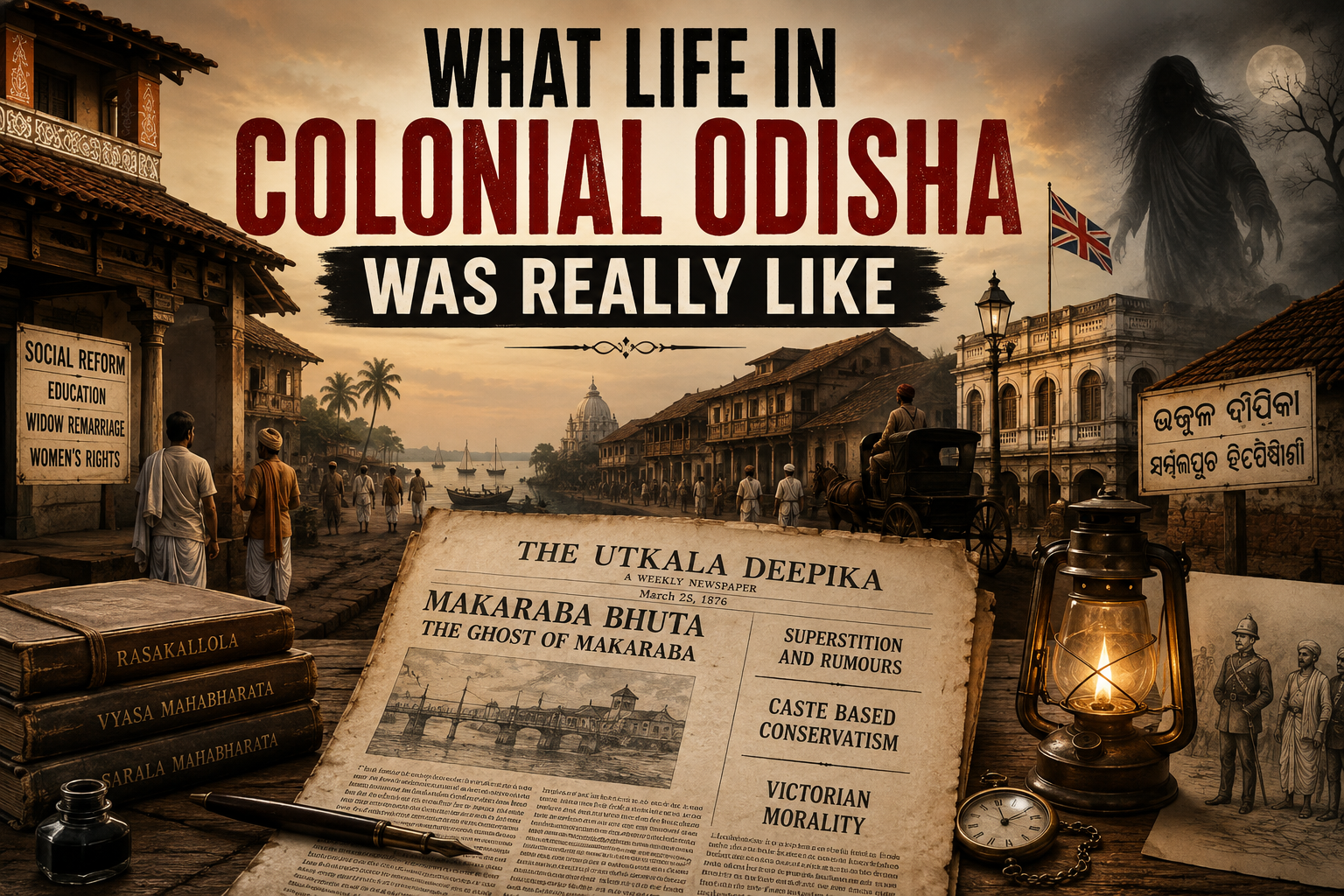
The past is always fascinating, in particular, the knowable past. Kalinga in the time of Ashoka or Kharavela is, generally speaking, less attractive than Odisha in the colonial days. To know about life in Odisha, more specifically coastal Odisha, in the last quarter of the nineteenth century, the best resources, to my mind, are the writings, both fictional and non-fictional, of Phakir Mohan Senapati, the preeminent Odia writer and thinker, and the Odia newspapers “The Utkala Deepika” and “The Sambalpur Hiteishini”, edited by the famous scholar Nilamani Bidyaratna. In Senapati’s work, one finds fictional reality, and in the newspapers, lived reality.
But let it be said that sometimes fictional reality can offer good insights into life and its problems. But a description of lived life has a quality of rawness about it which can be touching.
The Utkala Deepika was started as a weekly by Gouri Shankar Ray and Babu Biranchi Narayan Das, two well-known writers, thinkers, and public intellectuals. Ray was the editor. Both The Utkala Deepika and The Sambalpur Hiteishini disseminated news with a social purpose. They aimed to inform people, create an environment for public discussion and debate on issues, and thereby sought to play a role in bringing about change in the social and cultural life of those days. This article chooses its data from the invaluable collection of news reports and articles from this newspaper, titled “Sambadapatraru Odishara Katha” (roughly, “News about Odisha from the Newspapers”), by Sri Sudhakar Patnaik.
The Utkala Deepika, in its issue of March 25, 1876, published an article titled “Makaraba Bhuta (ghost of Makaraba)” in which it commented on how people accept things without thinking. Leaving out details, one day there was a rumour in Makaraba in Cuttack that a terrible ghost had appeared, having escaped from a pitcher and was killing whoever happened to come in its sight. Some said it had killed 10 people, others said 15, and some put the figure at 20. People were scared. The colonial administration took the matter seriously and posted two constables there to warn the non-local passersby about the ghost.
One day, some brave people went to the area where the ghost was supposed to have escaped from the pitcher. They made enquiries, and the people living there told them that they knew nothing about any ghost. One day, a bullock cart had overturned there, and on another, an old man dozing on the bridge had fallen onto the road. On another day, a cowherd’s clay container, with ghee in it, had broken. In their imagination, people had created a malignant ghost. So full of ghosts of all kinds were their heads that they immediately explained any odd happening as the doings of some ghost or the other. It did not occur to them to verify what had happened. The news report strongly censures people for this attitude and for readily yielding to all kinds of superstitions. In a tone of disgust, it expresses concern that it may take quite a while for people to free themselves from their utter stupidity.
What I miss in this report with a reformative objective is some observations on the administration’s posting of two constables. This shows that the administration was as receptive to the ghost narrative as the people. Instead of checking the facts, disseminating the correct information, and educating them that there was no ghost, it supported their superstitions and the rumours. This act of the administration was unworthy of any administration committed to public welfare. The news report’s silence on the administration’s role is not understandable.
The British gave the Odias not only a government but also an attitude, which we can call “Victorian morality”. Thus, many began to view the great poet Dinakrushna Das’s famous composition “Rasakallola” as erotic and indecent. The news item, published in The Utkala Deepika on 15.2.1868, does not deny the eroticism in the work but disapproves of people’s failing to appreciate the quality of poetic expression and dismissing the work as obscene.
Praising Krushna Singh’s Mahabharata as a faithful translation of Vyasa Mahabharata, it sharply criticized Sarala Mahabharata for frequently deviating from the original. The news calls the digressions ashuddha, which in this context means “impure”. That Sarala Mahabharata deviated significantly from Vyasa Mahabharata was known, but it was never criticized as a flaw. In fact, by the time Krushna Singh’s translation was published, a rich body of Sarala Mahabharata literature had emerged, based on the differences between Sarala Mahabharata and Vyasa Mahabharata. People had set all these aside as a result of subscribing to the colonial attitude to translation, namely that the translation must be strictly faithful to the original.
On 27.5.1876, The Utkala Deepika published a news piece on the caste-based conservatism of the Odia karanas. They were considered next only to the brahmins in the caste hierarchy. They were traditionally educated and did administrative jobs under the zamindars and feudal kings. They were scribes and record keepers. They often used a script known as “karani”. The use of that script was restricted to the karanas, and it is said that that script was one of the sources of their power. Details are out of place here. Bengali kayasthas were said to be the equivalent of the Odia karanas in every respect. Like them, they were educated, held positions of power in the local administration, and were scribes and record keepers.
But the Odia karanas did not agree with this equivalence. They thought they were inferior to them, despite belonging to a caste generally considered the same as their own. As such, they would not eat cooked food, such as poori and vegetable curry, in the Bengali kayasthas’ homes. This seems to have been accepted by the latter. The news does not explain why it was the case. To resolve this matter, a meeting was held in Babu Harekrushna Das’s house (the news report says nothing about this influential person), and it was decided there that for the Odia karanas to eat poori and vegetable dishes, the items should be cooked by a brahmin cook, then offered to Lord Salagrama, and then the Odia karanas would partake of the prasad (sacred food) of poori and vegetables in the homes of the Bengali kayasthas.
The news report disapproves of this practice fairly strongly. It rejects the Odia karanas’ assertion as untenable that the Bengali kayasthas and the Odia karanas were not similar in terms of caste and subcaste. Refusal to eat cooked food at the homes of the kayasthas without it being sanctified by being offered to a deity was entirely unjustified, according to the news. We consider this a meaningful reformist act.
(The views expressed are the writer’s own)

Prof. B.N.Patnaik
Retd. Professor of Linguistics and English, IIT Kanpur
Email: bn.patnaik@gmail.com
(Images from the net)