

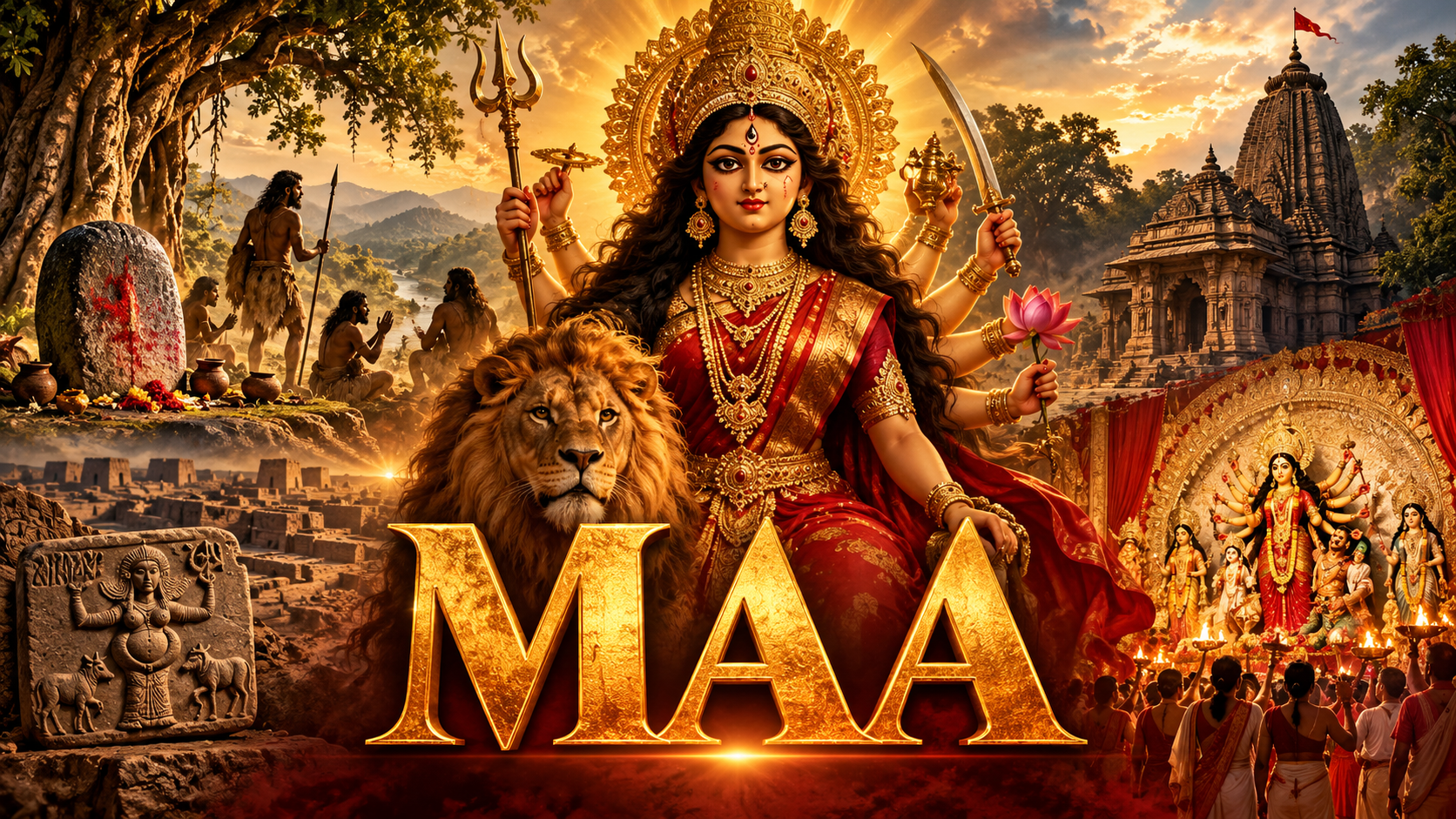
Life has not reached its present form all of a sudden. It has taken thousands and even lakhs of years for flowering and culminating in the life of today. When man started off in the primitive stage, many things must have appeared like a riddle to him. Lightning and thundering above, the sun, moon and the stars shining in the sky, earthquakes and even the flooded river must have aroused a sense of eeriness in him. He was born and brought up on the lap of his mother and had reposed great faith in her. So, whenever the elements of nature have brought about a sense of fear, he has exclaimed, Maa. For him, there are two Mothers, one with him and the other around. Both give him protection, keeping him ensconced on their lap.
The concept of the Mother Goddess or Maa is a gradual development. From the primitive stage to his present form, man has visualised Maa as per the development of his consciousness. Whenever we move in the jungles, which were the abode of man, we can very well see Banadurga and other goddesses from place to place. These goddesses guarding the jungles, riding wild animals, and stories associated with their origin make it clear that man has installed them as his saviour. Then, when he has settled down in the village and taken to farming, he has transferred the goddess from the jungles to the village as Gramadevi or Gramadevati. The final stage has been the town or city. In most cases, a village or a settlement takes the form of a huge city, and the local goddess becomes the presiding deity of the city. Kali in Kolkata, Mumbadevi in Mumbai, Katakachandi in Kataka, and Samaleswari in Sambalpur are cases in point. Since these goddesses are associated with local rituals and traditions, their local and humble origin is hereby proved. Most probably, from the period of village life, most families have adopted an Ishtadevi, which may or may not be the Gramadevati or the popular local goddess.
My childhood days have been spent in the midst of stories involving mostly the local gods and goddesses. Old men and women who either resided in our locality or came to our house on festive occasions and during family functions filled our minds with stories denoting the miraculous powers of gods and goddesses, which left indelible impressions on our minds. One old woman used to say how goddesses like Samlei or Samaleswari, Gramadevati or Bindhyabasini, appear at night on horseback with a sword, shout at the top of their voice, and warn people against forthcoming danger or natural calamities. Diseases like chicken pox and cholera are also considered to be evil goddesses who either enter an area without the knowledge of the local goddess or whose warnings people fail to receive. It is also known that, with great difficulty, these evil goddesses impress upon the local deity their intention of entering an area and taking a toll of lives. We have been listening to such stories ever since our childhood days, though, after the departure of the old men and women from our midst, the circulation of such stories has come down.
Though the script of the Indus Valley Civilisation, as found at the sites, has not yet been deciphered, the excavation of seals with pictures of the Mother Goddess on them has made it clear that the Indus Valley people were worshippers of a Mother Goddess. This happened five thousand years ago, when people had become far more developed and civilised than the primitive man. It is also known that the Indus Valley people were followers of a God like Siva or Pashupati. Thus, it can be ascertained that, much before the Indus Valley period, man had already developed the concept of a Mother Goddess along with a male power or God. People may change, but a continuing concept hardly changes. During the Vedic period of the Aryans, which succeeded the Indus Valley period, the Mother Goddess has not only continued but has also developed.
The concept of the Mother Goddess or Maa has undergone changes through the ages. In the beginning, she was a stone either on a hill or under a tree, giving people protection from wild animals and natural calamities. During this period, people ate raw meat and offered it to her as Bhoga. This took the form of animal sacrifice in later times. Then, when man became civilised, he gave a new form to the Mother Goddess. From an open space, she was transferred to a temple. But in most places, her abode has been kept as original as possible, as the man living in the jungle did not want to change the tradition. Even in Siva and Devi temples, priests of primitive or tribal origin are engaged in the task of worshipping. During the Vedic and later periods, the Mother Goddess has been polished and developed. In ancient and mediaeval times, kings and emperors have patronised the Shakti cult. Presently, though tribal people have stuck to their tradition of the Mother Goddess, she has become a mass deity of both Aryan and non-Aryan communities, and temples can be built at any time and in any place at present.
Devi Tatwa is very deep-rooted and difficult to understand. According to the followers of the Shakta cult, Devi is the main deity, and Brahma, Vishnu and Maheshwar are only offshoots from her. She creates, maintains and destroys, or gets it done by the gods. She is, therefore, the mother of the gods. Then, at the second layer, there are Parvati, Luxmi and Saraswati. As the consort of Siva, Parvati has a greater role to play. In the Jagannath Temple of Puri, Bimala, who is a form of Parvati, Luxmi, who is the consort of Vishnu, and Subhadra, who is the sister of Krishna and was married to Arjun, are all worshipped in the same premises. So, Devi, as mother, sister and wife, is manifested in three forms. Devi Tatwa is so interwoven and projected by our sashtras and puranas that one has to really work hard to follow it.
Our festivals have also been beautifully juxtaposed with our tradition. Every year, Dussehra comes in the month of Ashwina with the message that good would always triumph over evil. Durga in nine forms is an offshoot from Parvati. When the gods failed to kill the demon Mahishasura, Durga appeared as Maa and killed him in the interest of mankind.
Shaktism in the holy land of India is as old as the Indus Valley civilisation, dating back to five thousand years and even earlier in its primitive form. Then, during the period of the Aryan expansion and later ancient and mediaeval times, the concept of the Mother Goddess spread to the nook and corner of the country. Scriptures like Devi Bhagavatam and Devi Mahatmya came into being, thereby popularising the concept further. Kings and emperors adopted her as their presiding deity, and most of them also installed her as the protector of the royal forts. On the model of Lankini or Lankadevi, guarding the fort of Ravan, many goddesses, including Lankeswari, were given the charge of the preservation of forts. Though the statue of the Mother Goddess is very old, the tradition of Mrunmayee Durga Puja on stage is a much later development. It was highly popularised in the mid-17th century in West Bengal, the way Ganesh Puja in the 19th century was popularised in Maharashtra by Bal Gangadhar Tilak. Now, it has reached its peak in the northeast and east of the country. Devi appearing during Navratra and then until Dashami of Dussehra has not only popularised the Devi Peethas but also the Mrunmayee Durga pandals, so much so that people have been expecting her arrival every year and addressing her as Maa. The Dussehra Durga Puja has become synonymous with Devi Durga and the Mother Goddess as Maa.
(The views expressed are the writer’s own)
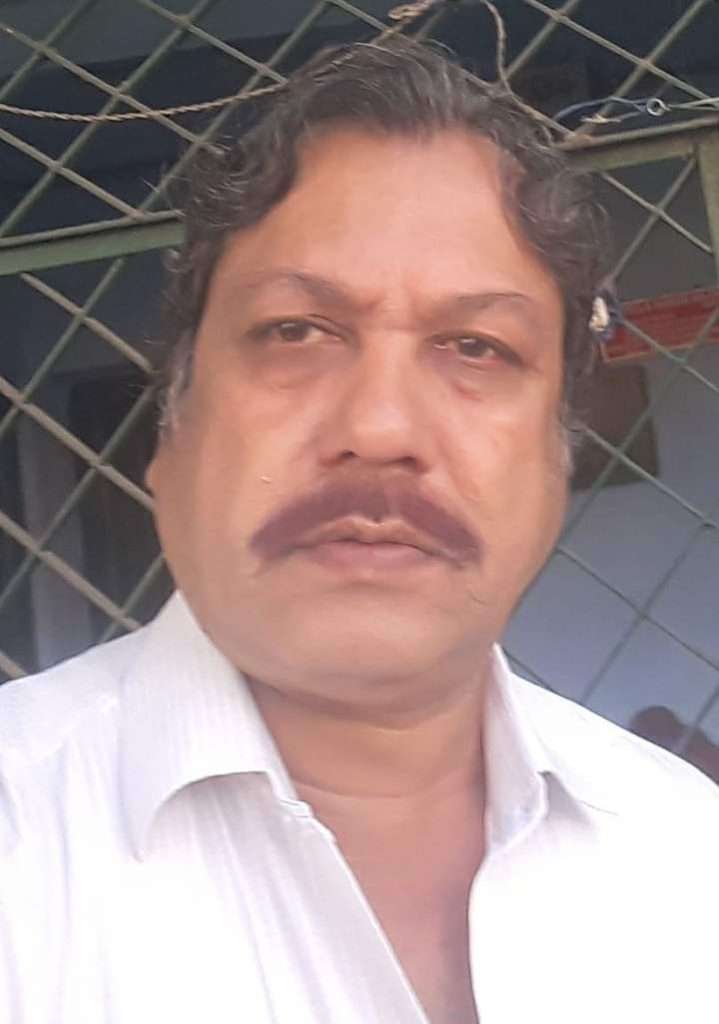
Mr. Prafulla Kumar Majhi,
Retired Asst. Director, A. I. R, is an eminent Scholar and freelance writer in English & Odia. His areas of interests are sociocultural, economic, literary, historical and analytical studies and writings.
Email: airprafulla61@gmail.com
Mobile.9861007190