

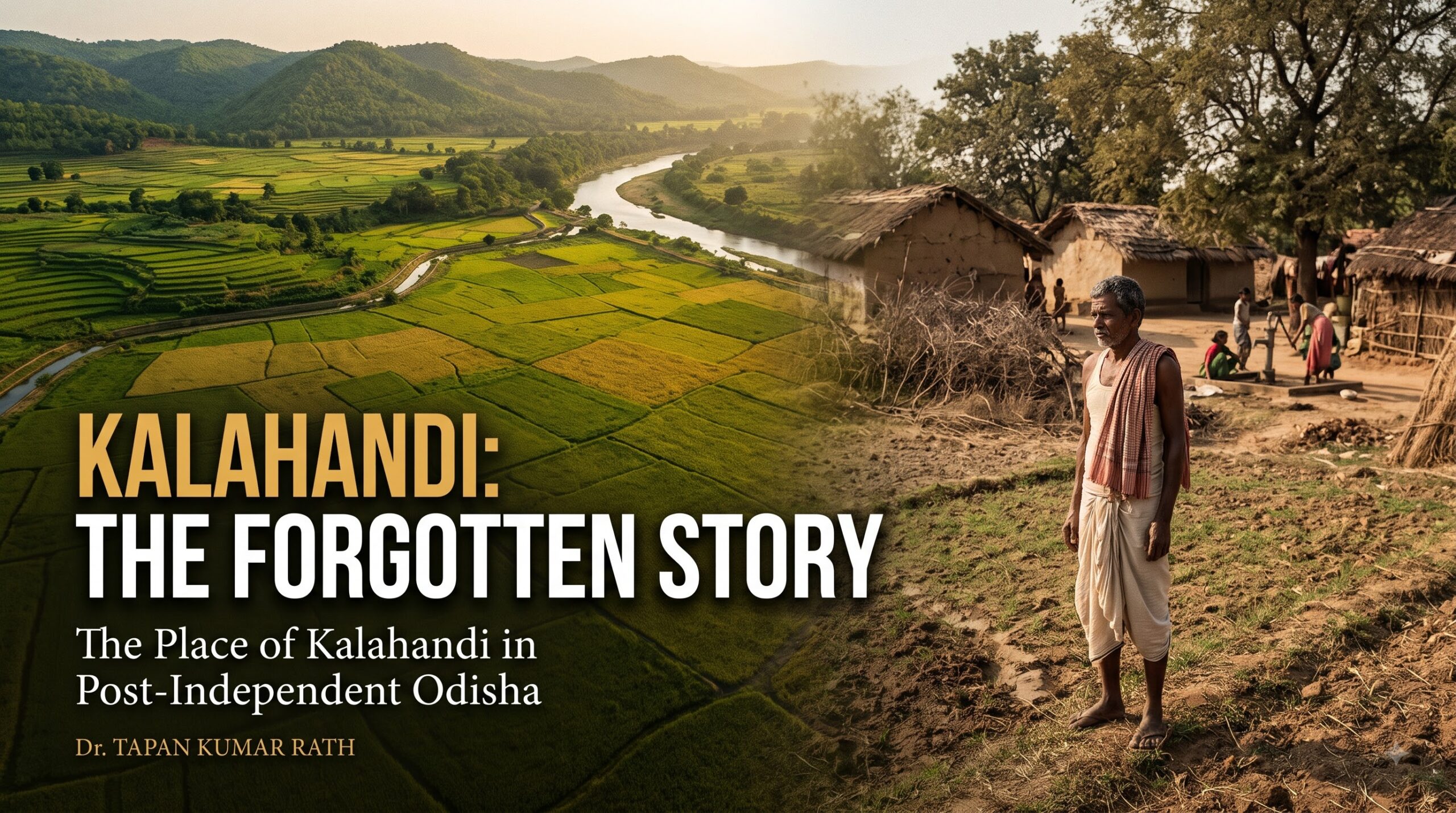
Kalahandi is a buzzword for the underdeveloped areas in the world scenario. There is definitely a political will behind it to let the people and the area remain in the same plight for reasons unknown to the innocent natives of Karunda Mandal, a cornucopia of precious stones like Karandam, Garnet, Neelam, etc., and the land which oozes the highest paddy, cotton and forest products. A formerly princely state or Gadjat of South Kosal and the then empire of Kalinga Utkala, Kalahandi has an area of 7,920 sq. km., which is 5.09 percent of the State.
Though Odisha was declared an independent province in 1936, Kalahandi remained an independent Gadjat State till November 1, 1949. It is, however, regretted that after independence, the growth of Odisha, as compared to many of the developed states of India, is very poor. It is, of course, the planners of Odisha who are responsible for the tardy growth of Odisha and Kalahandi, too. It has been observed that since the dawn of independence, most of the investments in development projects have been made in the pockets of coastal areas. Numerous universities, colleges, schools and hospitals are concentrated in a few districts, and other districts remain underdeveloped.
It is worth saying here that the complete development of a State would never be possible unless it reaches the poorest of the poor living in the last mile. It is beyond our comprehension how the ills of the policies have not been diagnosed so far and how the planners and the think tank of the State have not made any efforts to uplift the really poor and underprivileged areas. The failure of the plans in KBK districts is due to the ignorance of the masses and institutional failure.
The responsibility of the ignorant masses of Kalahandi lies in the fact that they are not aware of the development programmes prepared for them. In fact, they are yet to know that they are the masters of their own house. They are so timid that they don’t have the courage to ask questions about the projects being worked on in their areas. They still accept things without questioning. It is, of course, the gift of the yesteryears, the gift of nature and the gift of the rulers of the land. They are suppressed from raising their heads against any injustice done to them. They take suffering as pre-destined. They have developed a negative attitude towards life.
The ruling class takes advantage of this passive attitude of the people of Kalahandi and exploits them by appointing their agents in the district. They often go back on their words.
The tardy growth of a backward region like Kalahandi is due to the lack of integrity on the part of the educated and intellectual sections. The nonchalant attitude of the educated masses is to be blamed. Though they are able to keep abreast of the times and know about the developmental projects and the needs of the district, they never make the ignorant masses aware of the plans. They never dream of big things for the district. They remain confined to their own cells. They lack the vigour and enthusiasm to take advantage of a great project like the Indravati Hydro Project.
Similar is the fate of all the developmental projects. Power is being generated and supplied to other states. But the intellectuals never make it a platform for discussion. The glaring instance is the Sardar Raja Medical College, which is shut down, and a medical college is denied. The demand for a Central University in Kalahandi remains a dream. The demand for a Railway Wagon Factory is being shifted to another state. The people of Kalahandi could not even understand the conspiracy behind the shutting down of Western Sugar Ltd.
It would not be out of place to say that the tomorrow of Kalahandi is always blanketed by the dogged belief in Karma. This attitude tends to degenerate into fatalism and leads to passive resignation.
Kalahandi is backward because there is no infrastructural growth. At such a stage, the investment needs to be heavy. During the last decade, some investments have been made for infrastructural growth, like rail and road, and it is believed that the growth would be visible now. But the fact is that there is no immediate return on the investment. Consequently, only a handful of people are going to benefit from the investments immediately.
Many of the projects fail in Kalahandi. This failure is the failure of the government to reach the masses. The reason is obvious. The government never tries to reach the masses, who are the real beneficiaries. Kalahandi is deprived of all the development projects due to a lack of political will. Many of the projects are snatched away.
The government approaches the mass media or mediators, who often misguide the government machinery and provide wrong information and data. But the masses, for whom lakhs of money are spent on different projects, are completely ignored during the preparation and implementation stages, too. The government also never analyses the causes of its failure. It is regretted that the people and the government remain unconcerned about the failure. The literacy mission in the district is a failure. But no one tries to look into it.
Another cause of the failure of the projects is the vagaries of the monsoon.
Kalahandi depends on its agriculture and forest products. But the monsoon here plays a key role. So, the growth in production is also not constant. Kalahandi is known for its drought. Kalahandi, however, shares about three percent of the Gross State Domestic Product of Odisha. The average district share is 3.33 percent of the State GSDP. Agriculture is the main source of employment and income for 80 percent of the people of Kalahandi. The district contributes about 6.57 percent of the net sown area of the State. However, agricultural productivity is lower than the State average.
When it is the human element that is responsible for the failure of the projects, it is definitely the people of Kalahandi who will take Kalahandi ahead of the times. It is observed that growth in agriculture in Kalahandi has been made during the last decade. But the growth is in the production of paddy and cotton. Inclusive growth in agriculture is not possible when vegetables, nuts, wheat, fish, eggs, etc., are not included in agricultural produce.
Though Kalahandi supplies rice and cotton to other districts and states, it depends on every little agricultural product, starting from vegetables to eggs, from other states and districts. It is also found that agricultural productivity is lower than the State average. So, pisciculture, sericulture, poultry, dairy, etc., need to be encouraged in the district. The farmers need to do mixed farming to get more profits and avoid losses in paddy during drought. Besides, the farmers need value addition in all agricultural products. So, agro-based industries need to be established.
Agriculture in Kalahandi roughly supports two-thirds of the workforce. But the lion’s share of the funds for development work in Kalahandi goes to the non-agricultural sector. So, there is an urgent need to rectify this disparity to correct the historical wrongs.
It is agreed that in order to improve the quality of life of people in backward areas, the introduction of technology is required. For this purpose, electricity is the basic requirement. In Kalahandi, 60 percent of rural households are yet to get an electric connection. The electrification of rural Kalahandi is necessary to identify what is lying unutilised through information technology.
It goes without saying that education leads to the road to the upliftment of any community. Education does contribute to growth. But education is denied in some inaccessible areas of Kalahandi, though there are schools. These people are never assimilated into the growth process practically. These unreachable areas are left to suffer. So, such schools should be a home to the children and teachers, and residential schools should be established in such areas. For this purpose, some national ideal schools should be established. For higher education, an Agriculture University and a National University have been long-yearned-for and genuine demands.
Challenges are many before the people of Kalahandi. But they should not remain indifferent to them. They should look at these challenges as welcome ones. The biggest challenge is choosing one’s own attitude. The mindset needs to be changed. The attitude of the planners ought to be changed, and the Government needs to distribute all the big projects among the underdeveloped areas of the State. To Jacob Rus—
“When nothing seems to help, I go and look at a stonecutter hammering away at his rock perhaps a hundred times without as much as a crack showing in it. Yet at the hundred and first blow it will split in two, and I know it was not that blow that did it but all that had gone before.”
The people of Kalahandi need to develop an optimistic attitude towards challenges like widespread poverty, illiteracy, the critical power and energy situation, and the like. Constant efforts should be made by all, in all spheres, to bring Kalahandi into the mainstream. This incessant effort may one day bring growth embracing all. Then the dream of child-centred education, human-centred development and a knowledge-centred society would be possible in Kalahandi. The growth of Kalahandi and other backward districts would take Odisha to the zenith.
(The views expressed are the writer’s own.)
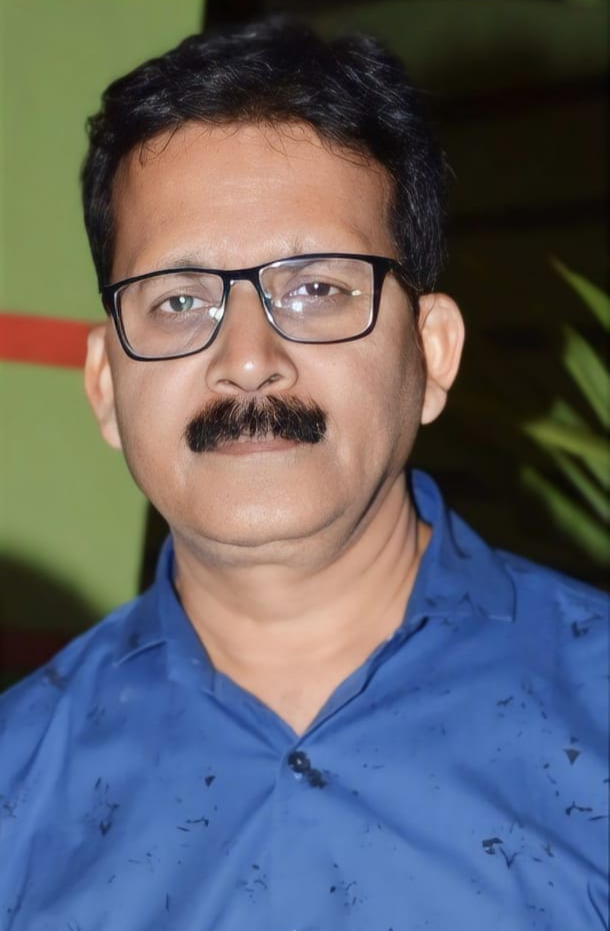
Dr. Tapan Kumar Rath is a Reader in English at P.S. Higher Secondary School, Karlapada, Odisha. His academic interests include English literature, history, culture and the traditions of indigenous communities. He takes a keen interest in exploring and documenting the rich cultural heritage and historical identity of Kalahandi.
Email: tapanrath11@gmail.com
(Photo has collected from net )