

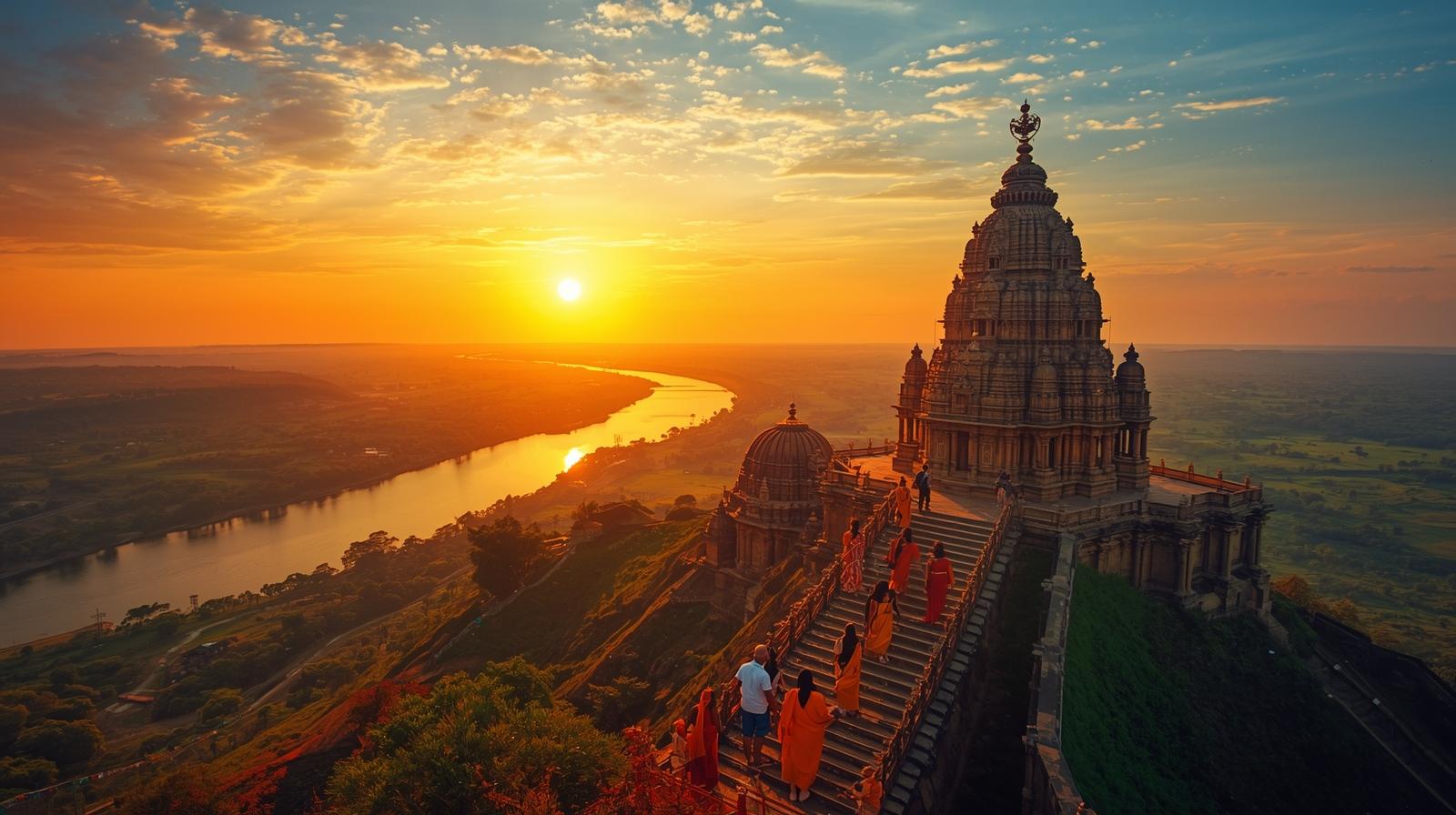
Approximately 130 kilometres from the city of Sambalpur and not very far from the Odisha state border, in the district of Bargarh, Chandrapur in the Janjgir-Champa district of Chhattisgarh state is a small town where there is the renowned Shakti Peetha of Maa Chandrahasini. The town is situated on the confluence of the rivers Mahanadi and Mand, thereby creating a holy place for the Mother. There are other routes to reach Chandrapur, but the route from the city of Sambalpur via Bargarh, Bhatli, Ambabhona, Bhukta, Sariya and Bonda appears to be the shortest from the western side of Odisha.
Origin of Maa in Chandrapur — There are mythological as well as historical stories regarding the origin of Maa Chandrahasini in Chandrapur on one bank of the river Mahanadi.
Mythological — Once Siva and Parvati were invited to Swarga by Devraj Indra. They were treated well by the Gods, and at the time of returning to Kailash, Devi Sachi, the wife of Indra, decorated Parvati’s hair with Parijata, a rare flower found only in Swarga. The flower was so beautiful that Siva was jealous at its sight and aroma and, in anger, split eight pieces of hair from his head and threw the same on earth. The eight pieces of hair fell on eight places of western Odisha and formed the Ashtashambhu Peethas presently in Sambalpur and Bargarh districts. These are Huma, Maneswar, Saranda, Sorna, Deogaon, Nilji, Gaisama and Ambabhona. In retaliation, Parvati split seven petals of Parijata flower and threw the same on earth, which fell on seven places of western Odisha, i.e., Samaleswari, Metakani, Sureswari, Manikeswari, Pataneswari, Ghanteswari and Chandrahasini. It may be mentioned here that Chandrapur, where Maa Chandrahasini sits, is not far from the border of western Odisha. In these seven places, Parvati gets worshipped as Saptachandi, which have become very popular with the devotees.
There is another version of the same myth. The return from Swarga and Parijata flower remains the same. The only difference is that while returning from Swarga, both Siva and Parvati were enamored of the natural beauty of western Odisha from above and decided to stay over here. As per the earlier myth, Siva threw eight pieces of hair and Parvati threw seven petals of Parijata and made settlements in the said places. The natural beauty of western Odisha, including that of Chandrapur, bears a testimony to the myth.
There is yet another myth regarding the origin of Maa in Chandrapur. When Siva carried the dead body of Sati in his arms and, in anger, started Tandav, Lord Vishnu sent Sudarshan Chakra and cut the body of Sati into pieces so as to mitigate the anger of Siva and save the universe from total destruction. One of the fifty-two pieces had fallen on Chandrapur, thereby forming the Chandrahasini Peetha.
Historical — In the historical story too, the natural beauty of Chandrapur on one bank of the river Mahanadi gets mentioned. Once Devi Chandrahasini was moving in the Chandrapur area and was enamored of its natural beauty. The place was so alluring that she fell asleep in deep slumber for a long, long time. Chandrahasa, the king, was moving in the Chandrapur area on his horseback, which trampled upon Devi’s body. Devi was very much disturbed in her sleep but forgave him as a Mother. But at night she appeared in his dream and said that she was present in the place and ordered him to build a temple over the place and worship her as Chandrahasini. She also ordered the king to build a temple for her sister Nathal Dai on the other side of the river. It may be mentioned here that Chandrahasa, the king, gets mentioned only in the Mahabharata epic, known for his sword. His historicity can hardly be confirmed as a king of Chandrapur since his time may date back to five thousand years. Sometimes it so happens that mythical and folklore characters get as much prominence as the historical characters and remain in hearsay for thousands of years. Naturally, the story of Chandrahasa, a king of ancient Chandrapur, is widely in circulation in the area.
There is another story which seems to be semi-mythical and semi-historical. Once a man, being instigated by his second wife, threw his little son into the river Mahanadi at Chandrapur and fled away. But Maa Chandrahasini rescued the little boy from water and handed him over to a fisherman. The miraculous power of Devi came to limelight, and the little boy started worshipping her as Chandrahasini. Since then, the family successors of the boy have been worshipping her. The story is quite popular in the area.
Miracles of Maa Chandrahasini — Maa Chandrahasini is round-faced and believed to be benevolent. She gives whatever her devotees ask for, and they never return empty-handed. The Mahanadi at the place has great width and passes on flood water during the rainy season. But the temple of Maa Chandrahasini and that of her sister Nathal Dai never get flooded, though flood waters almost touch the temples. One priest of Nathal Dai temple confirmed the same. People also claim to have heard strange sounds coming out of the temples and the two Devis, Chandrahasini and Nathal Dai, conversing with each other at the dead of night.
What to see around — The temple of Maa Chandrahasini is on a hillock, and there are well-built steps with railing for the devotees. The temple has structures of a huge statue of Veer Hanuman, the churning of the ocean with Siva drinking the poison, Draupadi being humiliated in the Kuru Sabha, a tunnel, and Bhoot Bangla for children and visitors. From atop the hillock, the Mahanadi, with its captivating natural scenery, presents a breathtaking sight which often attracts the devotees, visitors and tourists.
Before entering the temple, the temple market offers a variety of items to the visitors for purchase, including fancy and Puja items. A beautiful Jagannath temple has been built near the market, which attracts the tourists.
A visit to Maa Chandrahasini in the town automatically entails a visit to the temple of Maa Nathal Dai, situated at the meeting point of the Mahanadi and Mand rivers, presenting a panoramic view. The temple can be reached by a bridge. Private boats can also be hired, which often ply between the two Peethas. There is also a temple market before entering Maa Nathal Dai temple.
Maa Chandrahasini and her sister Maa Nathal Dai sit in Chandrapur to bless their offspring round the year. Though on Navratri and certain other occasions there is a huge gathering, devotees often visit the Peethas at any time of the year. Maa is benevolent and fulfills the desires of her devotees. There are motorable roads from various places up to the Peetha since it has gained much popularity in the area. Since Chandrapur is not far from the Odisha border, traces of Odia culture can be found over here and in nearby areas. The powerful Shakti Peetha of Maa Chandrahasini and Chandrapur, with its breathtaking natural sights, must be visited at least once.
(The views expressed are the writer’s own)
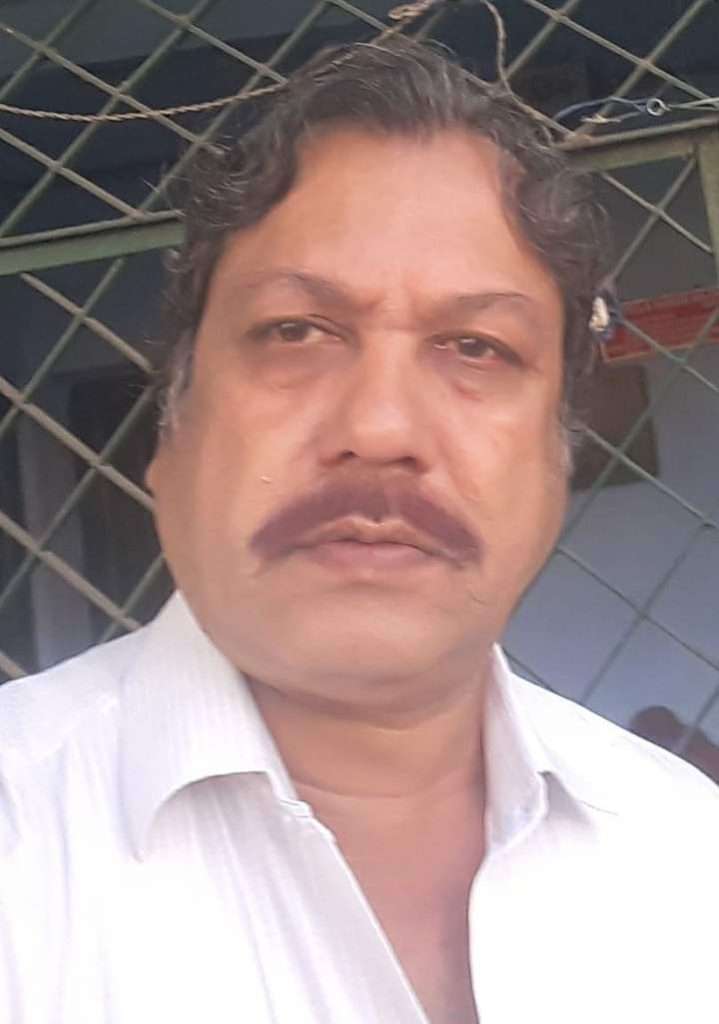
Mr. Prafulla Kumar Majhi,
Retired Asst. Director, A. I. R, is an eminent Scholar and freelance writer in English & Odia. His areas of interests are sociocultural, economic, literary, historical and analytical studies and writings.
Email: airprafulla61@gmail.com
Mobile.9861007190