

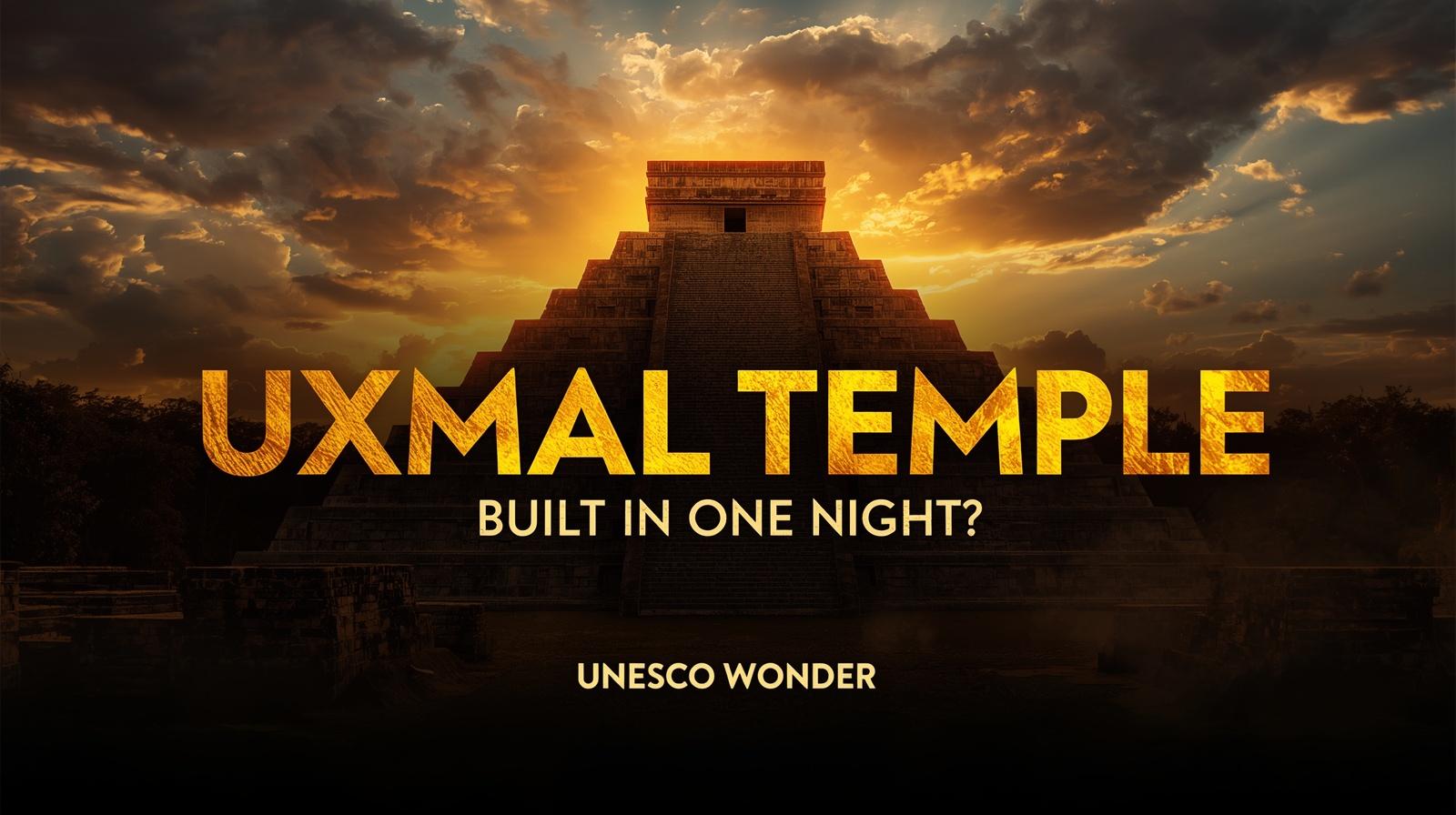
Uxmal is an ancient Maya city of the Classical period during the Maya civilization, located in present-day Mexico. It is the most important site of Maya culture. It is designated as a UNESCO World Heritage Site. Uxmal is located 62 kms south of Merida, the capital of the Yucatan state in Mexico. Its buildings are famous for their size and decoration.
Its buildings are made in the Puuc style. Smooth low walls represent the walls of huts. The buildings take advantage of the terrain to gain height and volume. The Pyramid of the Magician is the best example, which was built in five levels. The Governor’s Palace covers an area of 12,917 sq ft.
Uxmal means “three times built.” This indicates the antiquity of the site. Another view is that Uxmal means “what is to come, the future.” It is believed that it was built in one night by the Dwarf King. It was considered an invisible city.
The Pyramid of the Magician is a stepped pyramid structure. The outlines of its layers are oval or elliptical in shape. It was a common practice at that time that new temples were built atop older ones. But here, a new pyramid was built to the east of the older one. It is believed that the pyramid was magically built overnight during a series of challenges issued to a dwarf by the ruler of Uxmal. The dwarf’s mother arranged the trial of strength and magic to compete against the King.
Here it may be mentioned that this pyramid is not a leaning structure. The irony is that it is not leaning, but it looks leaning due to multiple layers of construction.
Queen Elizabeth II of the United Kingdom visited the site on 27 February 1975 to inaugurate the light show. But a sudden downpour occurred when a Maya prayer was chanted to Chaac (the Maya rain deity). This speaks of the spiritual wonder of the Maya civilization. British anthropologists have also said, “There are two worlds: Physical and Spiritual.”
The Maya city flourished between 600 and 1000 AD. The city served as a dominant capital in the Puuc region from the 9th to the 11th centuries. As there were no natural bodies of water, residents built underground cisterns to store rainwater. Construction stopped after 1000 AD, and the city was abandoned around 1450.
Main Structures
- Pyramid of the Magician – Built in five phases.
- Nunnery Quadrangle – A massive four-building complex with 74 rooms. It was probably used as a school, palace, or administrative centre.
- Governor’s Palace – The finest structure of Maya civilization with extensive mosaic decorations.
- Ball Court, the House of the Turtles, and the Great Pyramid.
The site was first recognised in the 17th century, and later explorers studied it in the 1840s.
(The views expressed are the writer’s own.)
Radhakanta Seth is a Former Income tax officer in Sambalpur. He is a Freelance writer and his articles have been published in some Oriya dailies like Sambad, Samaj, Dharitri and English dailies like The Telegraph and in a sociological journal ‘Folklore’ published from Kolkata.
(Photo has collected from net )