

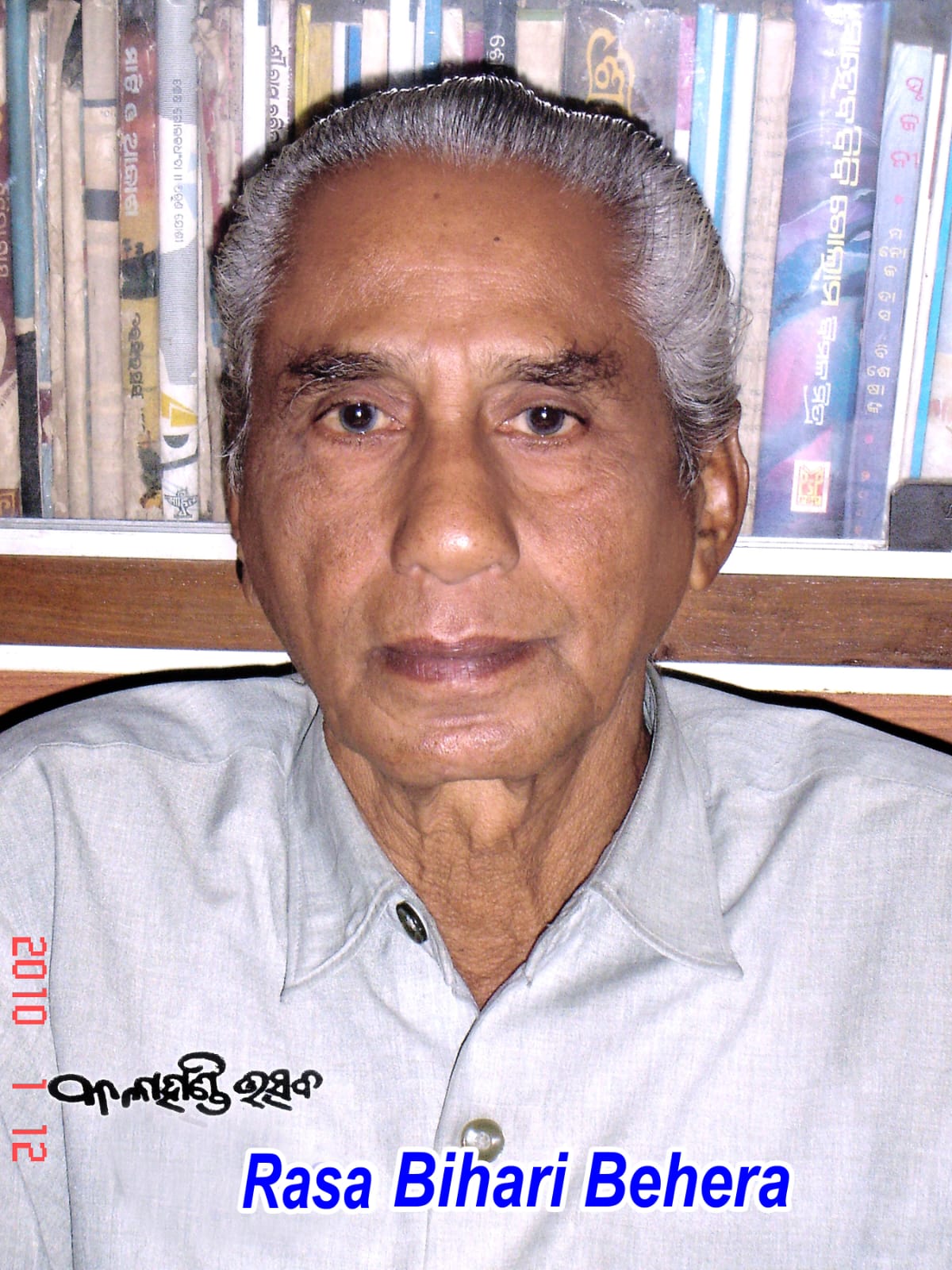
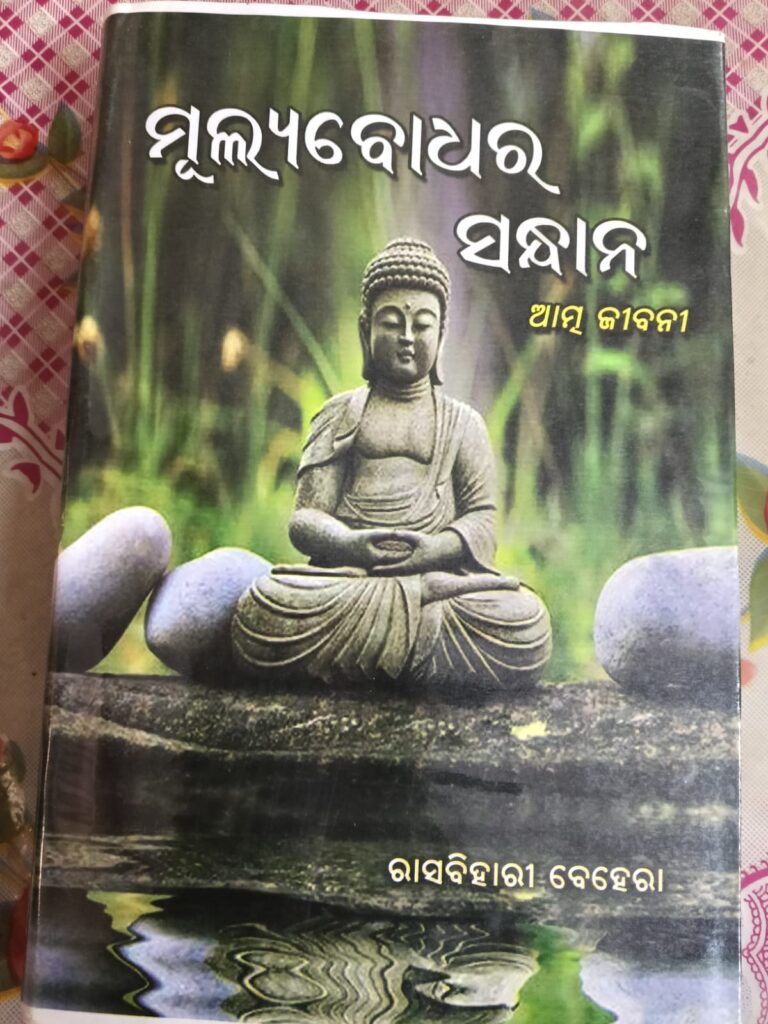
Sri. Rasabihari Behera’s Mulyabodhara Sandhana is more a well-documented testimony encompassing more than six decades’ history, heritage, art, culture, customs, literature, sports, politics, journalism, education, agriculture and, what is more, men and manners of Kalahandi, than a mere autobiography of one of its most distinguished sons. Spread over twenty-one chapters, the work unfolds like twenty-one meaningful steps descending deep into the author’s eventful life, each chapter bearing the imprint of a distinct phase marked by struggle, perseverance, achievement and self-realization. What elevates the autobiography above the ordinary is its rare ability to transcend the confines of a personal narrative and emerge as a living chronicle of a region, its people and its values. The author takes the reader through the lanes of memory where individual experiences harmoniously blend with the socio-cultural evolution of Kalahandi, a land often misunderstood by outsiders but endowed with a rich legacy of resilience, creativity and human warmth. With remarkable objectivity, candour and humility, Sri Behera recounts the triumphs and tribulations of his life, never allowing self-glorification to overshadow truth. Consequently, every chapter becomes a mirror reflecting not only the life of the auto biographer but also the aspirations, anxieties, joys and sorrows of an entire generation. As one traverses these twenty-one chapters, one invariably discovers an abiding faith in human values, a steadfast commitment to duty and an enduring belief in the triumph of goodness. Thus, Mulyabodhara Sandhana stands as a moving testament to a life nobly lived and to the timeless values that lend meaning and dignity to human existence.
MULYABODHARA SANDHANA VIS-A-VIS ESSENCE OF AUTO BIOGRAPHY :
Autobiography is a rare and distinct literary art.It was originated from the human desire to keep one’s memorial with the passage of time. The term ‘autobiography’ was first used by the poet Robert Southey in 1809 in the English periodical, ‘Quarterly Review’. The following parameters constitute the essence of an autobiography :
I. Truth
ii. Selection of events
iii.Subjectivity and objectivity
iv. ‘Self ‘as centre
v.Detached view of the ‘self’
Webster’s World University Dictionary defines autobiography simply as:
“A story of a person’s life told by himself”
Dr. NRUPA RAJ SAHU, Collector, Sonepur and Ex-Registrar, Sambalpur University and translator of the autobiography of the illustrious Kalahandi Maharaja P. K. DEO writes :
“ Reading the autobiography, the readers of Odisha can know a lot about many an event of the then India and the world as well(Page-14,Mo Smruti Mo Anubhuti)”.
On reading the autobiography of Sri Behera, ‘Mulyabodhara Sandhana’ with sheer objectivity, a reader can inevitably discern and discover the aforesaid parameters and will have no inhibition in acknowledging it as An autobiography par excellence.
CONTRIBUTION OF KALAHANDI TO ODIA AUTOBIOGRAPHY :
‘Mulyabodhara Sandhana’ seems to be perpetuating a literary legacy initiated by the doyen of Odia literature, Sri Fakir Mohan Senapati through his autobiography –‘ATMA JIVANA CHARITA’ .There is no dearth of autobiographies written by poets, writers and creative artists of Kalahandi. In this context, Dr. (Prof.)DASHARATHI ACHARYA, a celebrated essayist of Kalahandi writes :
“Though less in quantity , the tradition of Kalahandi’s autobiographical literature proves to have satisfied the hopes and beliefs of Fakir Mohan. (Odia Atma Jibaniku Kalahandira daana, The Girijhara, 2017)”
The following writers of Kalahandi have enriched the autobiographical literature
- Gaon ra Daaka :Dr(Prof.) Bhubaneswar Behera
- Memoirs of a bygone era:Maharaja P. K. Deo
- Mo Smruti Mo Anubhuti:Original English -Maharaja P. K. Deo
:Odia Translation -Dr. Nruparaj Sahu
- Hajila Dinara Katha: Sri Gobinda Ratha
- Mo Khela Ghara : Natyarashmi Prafulla Ratha
- Atma Katha : Sri Kali Prasad Mishra.
- Mo Jeebana Smruti: Sri Chinta Mani Mahapatra
- Bhola Jagatara Abhula Smruti: Sri Bhawani Shankar Panda.
STUDY OF MULYABODHRA SANDHANA WITH RESPECT TO QUEST FOR HUMAN VALUES:
The autobiographer, Sri Rasabihari Behera has rendered in different time and phases of his life the role of an ideal teacher, creative writer, organiser, farmer, Journalist, Editor of literary magazine and News paper,M. L. A, M. P, Cabinet Minister, Social worker, founder of educational, cultural, religious and sports Institutions, a social reformer and so on.what renders his personality truly unique is the moral and human dimension that permeates every facet of his life. Whether in public office or private life, he remained steadfast in his commitment to truth, objectivity, sincerity, humility, and human welfare. To my perception, he emerges not merely as a successful public figure but as a genuine humanist whose life was guided by an unwavering quest for values. Consequently, innumerable events, experiences, anecdotes, struggles, and achievements revolving around his multifaceted personality bear testimony to the spontaneous manifestation of these values. Since it is beyond the scope of the present article to examine every aspect of his rich and varied life delineated in the autobiography, a humble attempt has been made here to explore “Mulyabodhara Sandhana”from the perspective of human values and to trace their manifestation through selected incidents, experiences, and endeavours narrated by the autobiographer.
QUEST FOR VALUES IN CHILDHOOD:
Born on 13 June 1938 at the modest village Mahichala, about 40 KM away from the district head quarter, Bhawanipatna to the then renowned lawyer of the district, Sri Prasanna Kumar Behera and mother, Bidyutlata Behera manifested “Morning shows the day” as he had a passionate love for reading books since his childhood, which in turn,reared and nurtured his fledgling literary talent planting in his tender mind seeds of virtue, truthfulness, compassion and intellectual curiosity. Does this not substantiate his early quest for values, for he had already read the Ramayana, the Mahabharata, and other Hindu scriptures while he was still in Class VII?What reinforces his reading passion was his keenness on not sparing any book that he chanced to come upon and his incessant insistence on listening stories of varied tastes and flavour from his grand father and grand mother. In this context he confessed candidly as he said:
“The same reading habit lingers in me till date; for I can’t derive peace in mind unless I read three or four hours everyday.(Page-15,Mulyabodahra Sandhana)”
And reading habit undeniably manifests his quest for values.
The another incident that unfolds Mr. Behera’s quest for values even in his formative age is pertaining to the formation of “AKHILA CHANDRA CLUB”. It had been decided that each member of the proposed club had to contribute a fee of 25 paisa per month towards the construction of the club house, but the same fees had not been collected for months. Even the members were repulsive enough to pay the fees in time. In this context all praise for the tender-aged lad, Mr. Behera, a student of Class X then, who dared to go on fasting till the pending fees of the members got collected; even a placard showing “FASTING TO COLLECT THE PENDING FEES TOWARDS CLUB HOUSE” was pasted on the wall over there. The news that a small boy was on fasting for the cause of the club house was spread like a wild fire throughout the village, and in no time all the members huddled up there to pay their dues towards the construction of the club house. Thus the AKHIL CHANDRA CLUB came into being by virtue of an epitomic endeavour of a young lad, none other than the auto biographer himself, is certainly a stuff towards the quest for values.
QUEST FOR VLUES IN PROFESSIONAL REALM:
Sri Behera’s entry into the teaching profession at Dharamgarh High School in the 1960s marked the dawn of a career distinguished not merely by professional excellence but by an unwavering commitment to social welfare and human values. To him, teaching was never confined to the four walls of a classroom; it was a noble mission aimed at nurturing enlightened minds and building a harmonious society. Endowed with rare vision and leadership, he forged a bond of trust and affection among students, parents, guardians, and the local community, believing that collective goodwill alone could pave the way for genuine social progress.In continuation of such a laudable legacy, Mr. Behera apart from rendering his duty in school was instrumental in literary and cultural movement in then Dharamgarh. ‘KALAHANDI LEKHAKA KALA PARISHADA’ and ‘DHARAMGARH CLUB’ were the handiwork of Sri Behera’s visionary leadership while he was still serving as a teacher at Dharamgarh High School.It was not at all a rosy path for the same accomplishment. Even for the cause of Dharamgarh Club, he opposed the undue interference of the then S. D. O, Dharamgarh into the club affairs vehemently. In consequence, he fell prey to the anger of the administrator and eventually had to go to jail along with his five followers. Later it was learnt that the S. D. O had misused his power deliberately against Mr. Behera to satisfy his personal anger on the basis of the fact that Mr. Behera, instead of inviting the S. D. O, Sub- divisional head as the chief guest to the grand literary function held previously, had invited Mr. Murty, the then B. D. O, Junagarh. In fact, Mr. Murty was a reputed poet and prolific writer in Telugu literature. As such, how could Mr. Behera, being an ideal teacher prefer an administrative head to a literary stalwart for the inauguration of a literary function? This apart, Mr. Behera on perceiving the local people’s feelings and emotions in a meeting meant for the auspicious inauguration of a temple, built by means of lavish contributions of local people, suggested to name the shrine as “RADHA KRUSHNA MANDIR” in contrast with the S. D. O’s suggestion-“Braja Mohan temple” in reminiscence of Maharaja Braja Mohan Deo. Eventually, the Sub-divisional administrator had no option but to respect the people’s demand, not before conceiving a hostile attitude towards Mr. Behera, which had had its unpleasant culmination during Dharamgarh Club controversy.
QUEST FOR VALUES IN JOURNALISTIC REALM:
Though Sri Behera’s career as a journalist of THE KALINGA, a news paper under the patronization of the legendary BIJU PATNAIK was short spanned, nevertheless it speaks out in volumes a value-based artistically creative approach to journalism.
Inspite of being a young journalist working for a young News paper, for the Kalinga had had its birth afresh then, the sale of The Kalinga in Kalahandi was in ascending trend. Obviously it was because of the insightfully creative presentation of news items by Sri Behera, the district correspondent. What was creative presentation that said to have elevated popularity of the Kalinga was that news regarding Kalahandi got published separately at specific pages of the News paper, which in turn drew the interest of the readers in a big way.
During the students agitation in Odisha, huge copies of The Kalinga news papers were being burnt down all over the state by the students. Even the outrageous students snatched away huge bundles of the news paper from the Cuttack bus and subjected them instantly to fire. The sale of the Kalinga was declining shaply.Quite surprisingly, Kalahandi was exception in this regard as not a single copy of the Kalinga had been put to fire by any student. Sri Biju Patnaik, in the review meeting, was utterly surprised and asked Sri Behera for its clarification. The response of Sri Behera was insightfully creative as he said:
“ The news relating to Students’ agitation along with each and every student’s name, who delivered speeches at various meetings, got published in my reporting; having read their own names in the news columns,they became delighted. Obviously,they eagerly purchased copies of the Kalinga and shared the report joyfully with their friends; hence the circulation of the Kalinga in my district is in ascending trend. (Page-116,Mulyabodhra Anusandhana)”
QUEST FOR VALUES IN CULTURAL AND LITERARY REALM:
The Kalahandi Lekhaka Kala Parishad and Mahabir Sanskrutika Anusthan (MSA) have, over the years, become the living soul of Kalahandi’s cultural and literary life, embodying its heritage, aspirations, and creative spirit. Mr. Behera played the pivotal role in conceiving, rearing and nurturing these two iconic Institutions. The former was the out come of a literary congregation of poets and writers from all over the district convened by Sri Behera at DHARAMGARH on 28 and 29 April 1962.The latter came into being under the presidentship of Sri Behera at Bhawanipatna on 14 November 1962, coinciding with the birth anniversary of our first Prime Minister, Pundit Nehru.
The literary magazine SAGAR , published regularly under Sri Behera’s editorship on behalf of the Kalahandi Lekhaka Parishad, soon became a vibrant platform for creative expression. It inspired countless poets, writers, and young literary aspirants across Kalahandi by providing them with opportunities to see their creations in print. The magazine not only nurtured emerging talents but also fostered a sense of literary belonging among writers scattered across the district. Under the aegis of the Parishad, eminent literary luminaries of Odisha, including Raj Kishore Ray, Adhyapaka Gobinda Chandra Udgata, and Rabi Singh and others were invited to grace literary gatherings. Their inspiring speeches and intellectual interactions left an indelible imprint on the literary consciousness of Kalahandi. It would not be an exaggeration to say that the Kalahandi Lekhaka Kala Parishad gradually became the nucleus of a vibrant literary movement that transformed the cultural landscape of the district.
Sri Behera’s quest for values found expression not only through institution-building but also through his own literary creations. His writings embody the virtues he cherished and practised throughout his life. Works such as Prabandha Manjari, Prabandha Manjusha, Prabandha Samaroha, Bijayee, Adhikar, Sai Pahada Tale, Rakta Tirtha, and his autobiography Mulyabodhara Sandhana continue to inspire readers with their profound commitment to truth, morality, social consciousness, and human dignity. These works stand as torchbearers of virtue and veracity for generations to come.
In a similar manner, Mahabir Sanskrutika Anusthan (M. S. A) eloquently reflects Sri Behera’s abiding faith in cultural values. Since its inception in 1962, the institution has served as a dynamic platform for preserving, promoting, and perpetuating the rich artistic and cultural heritage of Kalahandi. Through seminars, conferences, workshops, and research initiatives on folk culture, folk art, and folk dance, it has ceaselessly worked towards safeguarding the district’s cultural identity. Sri Behera’s contribution in this regard was both visionary and tireless.It was Mr. Behera who left no stone unturned to pave the way for the performance of GHUMURA folk dance at ASIAD GAMES held in New Delhi in 1982.
Such achievements reveal his profound conviction that culture is not merely a repository of traditions but a living force capable of shaping identity, fostering unity and enriching human values.
QUEST FOR VALUES IN SPORTS REALM:
True to the spirit of autobiography, Sri Behera’s account of his association with games and sports is marked by striking objectivity and detachment, reflecting his unwavering commitment to truth and self-scrutiny. His passion for sports can be traced back to his childhood and continued unabated throughout his life. Even while serving as a teacher at Dharamgarh High School, he played a pivotal role in organising district-level football, volleyball, and badminton tournaments, earning widespread appreciation for his dedication and organisational acumen.
As luck has its own turn, Mr. Behera’s unanimous election as the Secretary of DISTRICT SPORTS ASSOCIATION, Kalahandi had changed, to a great extent,the course of sporting journey of the district. It was a challenging task for Mr. Behera; for he had to nurture it like an infant; and he was bold enough in rendering the groundwork ranging from preparation of bylaws, making documents for government registration of the Association to determination of the area for the proposed play ground.
By and by under the aegis of District Sports Association, Sri Behera was successful in creating a conducive atmosphere tinged with a genuine spirit and enthusiasm for Sports across the length and breadh of the district.More Particularly, organizing football tournaments at the rural level that drew thousands of spectators and fetching a Volleyball coach from ‘Sports Council’, Bhubaneswar for the girls, the then Infant district Sports Association was mustering overwhelming support,appreciation and credibility from the people.
In due course of time, the Association successfully organised rural, district and even state level football, volleyball, Badminton Tennis and Athletic tournaments on regular basis.
Sri Behera, as the Secretary of the District Sports Association, then still in its infancy, dared to envision a stadium at Bhawanipatna and, through his determination and perseverance, transformed that vision into reality. This remarkable achievement may justly be regarded as one of his most exemplary contributions to the promotion and development of sports in Kalahandi.Many a time, he stumbled against many obstacles on the way to materialise his dream for the stadium, but stood up he on his own with his inimitable conviction –“Where there is a will, there is a way”. Even he illustrated his conviction before the district Collector in a meeting of the Association in the collectorate by saying resoundingly that out of the 5 lakhs of then Kalahandi Population,at least one lakh people would turn up to contribute one rupee each towards the proposed stadium, provided everyone must have a collective but sincere and honest efforts for the same. The Collector was impressed instantly and responded smilingly with a positive note as he said-
“The thoughts behind your planning is quite acceptable to all. At the outset, I hereby donate Rs1/- towards the construction of the proposed Stadium(page-102,Mulyabodhra Sandhana)”
The Collector handed over his donation of Rs 1/- to Sri Behera and appealed the members present to donate as per their capacity. Thus a total of Rs47/- was collected in the meeting was no less than an initial but firm step towards erecting the Stadium. The small step mustered momentum and eventually, may be by the grace of Maa Manikeshwari, overcoming hundreds of hurdles in the course of its building , “LAL BAHADUR SHASTRI STADIUM ”came into being to foster the fate and fortune of Kalahandi’s games and Sports.
Came there yet another momentous moment for Sri Behera when‘THE ODISHA OLYMPIC ASSOCIATION’ entrusted him to render his role as General Manager of ‘Odisha Athletic Team” at theNATIONAL GAMES held at Durgapur(W. B) in 1973.Rendering his job immaculately by insisting strictly the athletes on adhering to utmost discipline and guiding them creatively, Mr. Behera as the team manager had become a part and parcel of a rare accomplishment since Odisha bagged 45 medals(18 Gold, 17 Silver and 10 Bronze), highest ever for Odisha team at National Games till then. At the prize giving ceremony when USHA RANI MISHRA, the Gold medalist and new National record holder in high jump,was being conferred with Gold medal amid the rendering of National Anthem,tears of joy rolled down spontaneously from the eyes of Sri Behera and Sri Bhairab Mohanty, the then President, Odisha Olympics Association as well. The emotional remak of Sri Mohanty has been recorded lively by the autobiographer as he writes-
“Yes, Rasabihari!, I have been waiting for this day for ages as to when Odisha will bag Gold Medal on creating national record. (Page-212,Mulyabodhra Sandhana)”
How tenderly touchy are the two approach of Sri Behera and their emotional response; 1st one being the remorse and regret expressed publicly with tearful eyes by the athlete whom Sri Behera had punished for violating the discipline during the National Games and thr 2nd one being Sri Behera’s soothingly cool approach that moved then collector so much that he became the 1st man to donate in the meeting Rs1/- for the constructional work of the stadium. Truly, Sri Behera could caress the core of the people around him.
QUEST FOR VALUES IN POLITICAL REALM:
Perhaps divine providence had destined Sri Behera to play a significant role in politics; yet, at heart, he remained more a sensitive humanist and artist than a conventional politician. Politics, for him, was never a pursuit of power or personal advancement; rather, it was a means of serving society and translating ideals into action. His sensitivity to human suffering, his concern for social welfare, and his unwavering commitment to public good distinguished him from many of his contemporaries.
Beginning his public life as a Ward Member and later serving as the Chairman of Bhawanipatna Municipality, Sri Behera steadily ascended the ladder of public service to become a Member of the Legislative Assembly (MLA), a Member of Parliament (MP), and eventually a Cabinet Minister of Odisha, earning each distinction through his merit, dedication, and unwavering commitment to the people. While rendering political role he was more a reformer than a politician. That is why he took up the challenge to turn the worst Municipality in to the best one. Construction of town Hall, erection of District Library and pipe water supply to Bhawanipatna town are some of his rare accomplishments. As M. L. A, M. P and Cabinet Minister of Odisha he had rendered his role immaculately and has left an indelible mark in the fields of education,agriculture,Irrigation horticulture, Co-operative reformation and others and has lived up to the expectations of the people.
CONCLUSION :
May be, in pursuance of the sublime line-“Beauty lies in the eyes of beholder”, Sri Behera has had observation towards life. Consequently, as a beholder of beauty he has been exploring human values in every walk of his life till date. And each and every page of his autobiography seems to document more than six decade’s events and evolutions of Kalahandi in panoramic pattern evoking the human values , virtues and veracity vivaciously.
REFERENCES:
1.Behera Rasabihari- Mulyabodhara Sandhana, Publisher:Grantha Mandir, Binod Bihari, Cuttack-2,2016
2.Dr. Nruparaj Sahu(Translator),Mo Smruti Mo Anubhuti,Pratap Keshari Deo, Publisher:Athena Book, Bhubaneswar,2023
3.Olney James, Studies in Autobiography,1st ed(New York/Oxford: Oxford University Press, 1988)
4.Webster World University Dictionary (Washington:Lewis Mulford Adams and others, Publishers co Ltd, 1965).75
4.Girijhara, Smaranika-2017,Topic:Odia Atmajibani Sahityaku Kalahandira Dana, Dr.Dasharathi Acharya
5.Kala Jharana, Souvenir -2010,Topic:Ek Atita Itihasara itibrutta, Sri Lingraj Patra
The views expressed are the writer’s own)
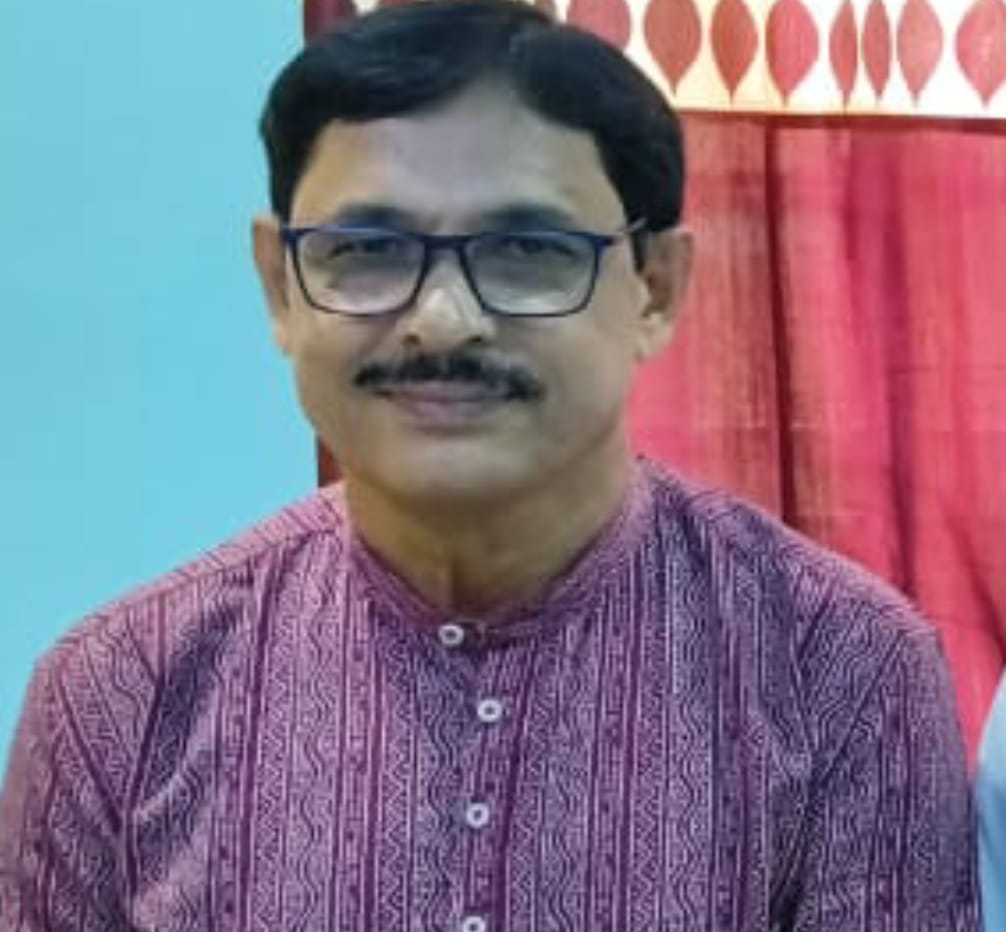
Bankim Mund
Lecturer in English
Dharmgarh Women’s Jr. College, Dharamgrh, Kalahandi Mob 8327717672
You can reach to him : bankim.mund@gmail.com