

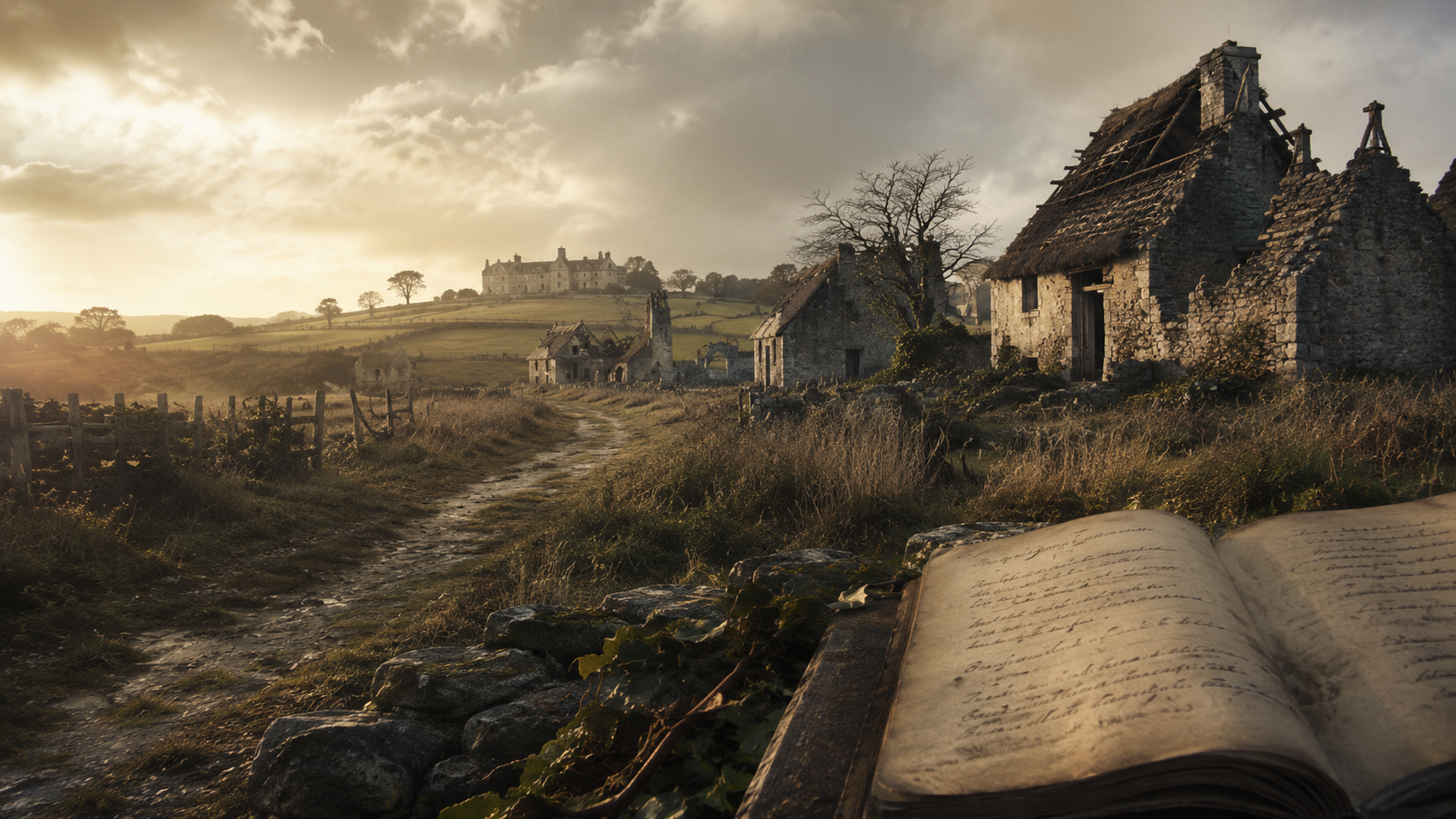
The Deserted Village is a poem by the English poet Oliver Goldsmith, published in 1770. It is a social comment on the depopulation of a village. This poem is a popular poem even today. Nowadays, villages are being deserted due to selfish reasons. People are leaving their villages on the pretext of education of children, comfort, and availability of employment. That is why Gandhi gave the slogan — “Go back to villages.”
But in Goldsmith’s poem, people in his native village left for America as their lands were taken away by landowners. Goldsmith opens the poem with nostalgia with the description of the village Auburn.
Sweet Auburn! loveliest village of the plain;
Where health and plenty cheered the labouring swain;
Where smiling Spring its earliest visit paid,
And parting Summer’s lingering blooms delayed.
The Present Condition of the Village
Then he says about the present condition of the village which has been deserted —
“Sunk are thy bowers in shapeless ruin all,
And the long grass o’ertops the mouldering wall;
And trembling, shrinking from the spoiler’s hand,
Far, far away thy children leave the land.”
“Ill fares the land, to hastening ills a prey,
Where wealth accumulates, and men decay.”
Goldsmith narrates the usurpation of agricultural land by the wealthy.
The man of wealth and pride
Takes up a space that many poor supplied,
Space for his lake, his park’s extended bounds,
Space for his horses, equipage and hounds,
The robe that wraps his limbs in silken sloth.
The Destruction of Rural Life
He has robbed the neighbouring fields of half their growth.
As the poem nears its end, Goldsmith becomes —
“Even now the devastation is begun,
And half the business of destruction’s done;
Even now, methinks, as pondering here he stands,
I see the rural virtues leave the land,
Down where yon anchoring vessel spreads the sail.”
The poem idealises a rural way of life, which has been destroyed by man’s greed, economic and political change. It is a 430-line poem. As a result of laws, aristocrats sought to extend their large estates by purchasing lands previously run by small private farmers. Unwilling to work under the landowners, the peasants leave the village for miserable urban life in England or America.
Really, it is a sorry state of affairs. Man is destroying his own paradise for the accumulation of wealth and power. The tone of the poem is nostalgic, elegiac, and melancholic.
(The views expressed are the writer’s own.)

Radhakanta Seth is a Former Income tax officer in Sambalpur. He is a Freelance writer and his articles have been published in some Oriya dailies like Sambad, Samaj, Dharitri and English dailies like The Telegraph and in a sociological journal ‘Folklore’ published from Kolkata.
(Photo has collected from net )