

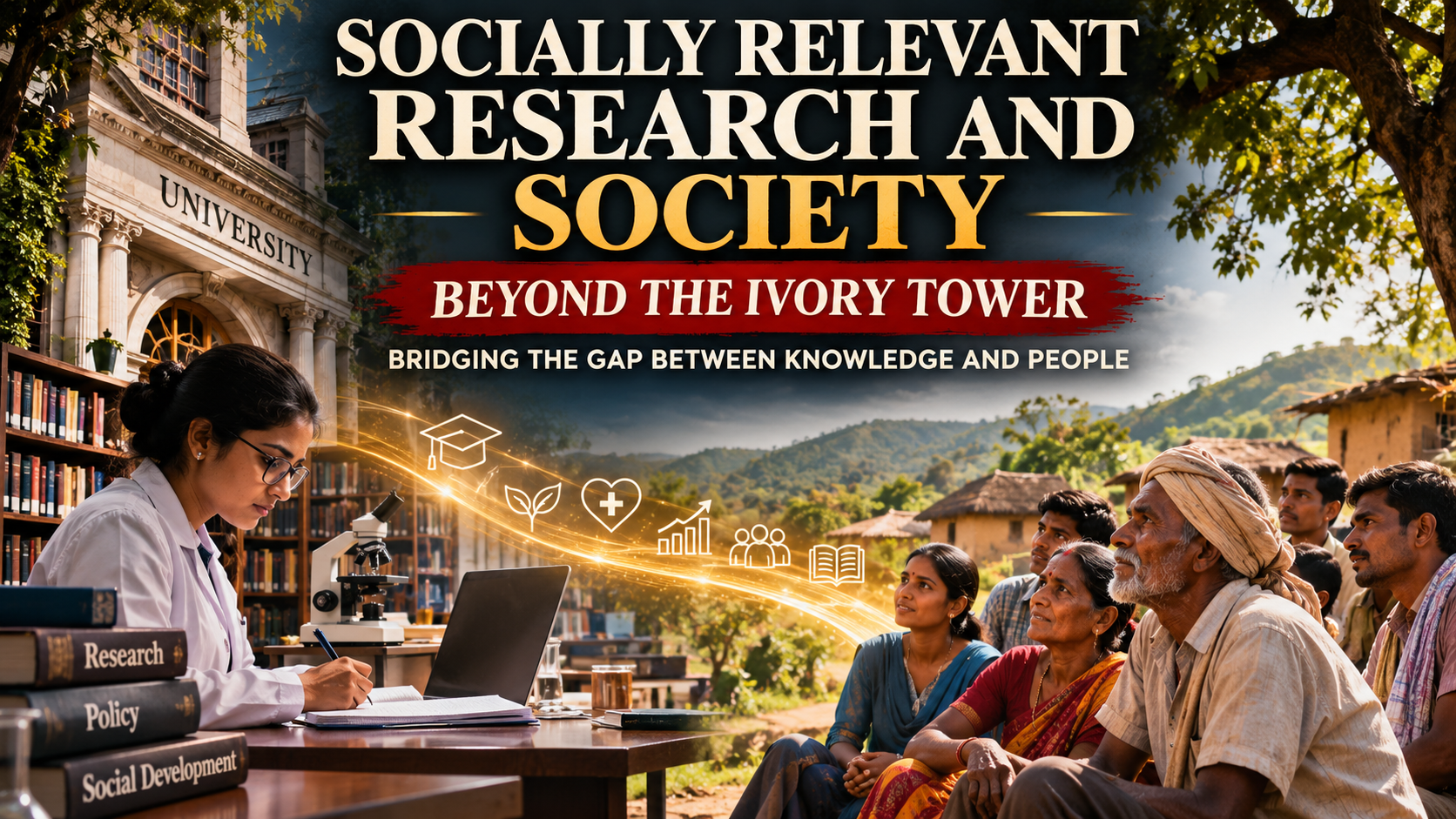
The National Education Policy 2020 (NEP 2020) recommends research at Higher Educational Institutions that contributes to social development (11.12). In fact, our academic community has long been aware of the need to create knowledge that can benefit society more directly. NEP 2020 has incorporated it as part of public educational policy for our country. Socially relevant research would address problems of society and suggest implementable solutions. Such research areas would include effective communication, environmental development, a healthy ecosystem, economic prosperity, sustenance, physical and mental wellness, pandemics, rehabilitation, education, social inclusion, welfare society, food, government practices, and industry, among others. Drawing on such research, experts would formulate policies, and the administrative machinery would prepare action plans to implement them.
By the way, NEP 2020 has underlined the importance of industry–academia partnership, which our industry has been talking about for years. The need for this cannot be overstated for development. India is a very fast-growing economy and aspires to be the third-largest economy in five years. In any case, industry–academia collaboration is already happening. These days, many higher institutes of technology strongly encourage students to take up internships in industry in their final semester of B.Tech. Responding to the needs of industry, they offer courses at the B.Tech. and M.Tech. levels.
At the same time, it must be kept in mind that the development of a country is not the same as the development of its industry. As for higher institutions of education, including technical education, they must not forget their primary commitment, namely, imparting global-level knowledge and sophisticated skills to their students, who would contribute to society, not merely as experts but as social thinkers. These institutions must not be expected to do research for industry. Industry must have strong R&D centres and engage in challenging projects to attract talent from educational institutions. In short, industry–academia collaboration should take place within this framework, in my opinion.
To return to the topic of this piece, the specific question here is what society gets to know from “socially relevant” research. The answer is very little, if at all. Some think that this is just not right. The knowledge created at research centres should reach people. They should benefit from an activity they indirectly pay for. As an argument, it is justified, but the matter is by no means simple. For academic research to reach people, certain things are needed. This is because of the nature of this research. This is essentially a matter of communication. NEP 2020 does not address this question; neither does the academic community by and large. In this context, it was good to see the article “How to Take Research Beyond the Ivory Tower” by Rich Rice and Soumya Kashyap in The Times of India on 20 October 2026. They say that platforms like “Saral AI”, developed at IIIT Hyderabad, could contribute significantly in this regard. I would add that human intervention is needed in translation. AI translations must be improved in terms of accuracy and style by competent human translators before they are made available to people.
Now, the target readership of academic research, for example, a doctoral work, is the academic community; more specifically, those from that field or a related area. For instance, a work in generative syntax has no readers who specialise in anthropology or economics. Academic research is normally available as articles in research journals. When the author of a doctoral dissertation wants to publish his (his/her/their) work, he modifies it for readability by minimising endnotes or footnotes, reducing jargon, sometimes shortening the long literature review chapters, etc. But such works do not really reach the general public.
For that, we need specialist translators who can present the essential ideas of research in non-technical language in an interesting way. We need such writers because, barring exceptions such as Jayant Vishnu Narlikar, researchers often lack the inclination or competence to engage in popular writing. Narlikar is a glorious exception, in fact. Michael Pollan’s Food Rules and David Crystal’s A Little Book of Language are excellent examples of popular human science writing. Having said that, unless popular knowledge is published as newspaper articles, for example, it is most unlikely to reach the general public. But that “general public” is not really so general, since it often constitutes the English-speaking public, which is a part of it.
Now, let’s pause and ask whether all this isn’t from the academician’s or the intellectual’s perspective. Is the common man interested in academic research? He is not. He does not even know about such research. It does not touch his life. It is too remote for him. It is not written in the language he understands.
It is the duty of the intellectuals to inform him about the knowledge being created in the Centres of Higher Education and Research Centres. He must be part of the informed society. Information dissemination empowers the marginalised people, and not just them. People who are well-informed can understand the world, or at least their own world, better. Ideally, the information intended to reach people at large, especially the marginalised, would be available both in their own language and in the language of wider communication for them. And, very importantly, it must give them information they would find useful or that they can relate to. This is an important challenge for the intellectuals and the State. Our policies of education and social development must recognise the importance of this.
(The views expressed are the writer’s own)

Prof. B.N.Patnaik
Retd. Professor of Linguistics and English, IIT Kanpur
Email: bn.patnaik@gmail.com
(Images from the net)