

The time dates back to 1971 and even earlier.
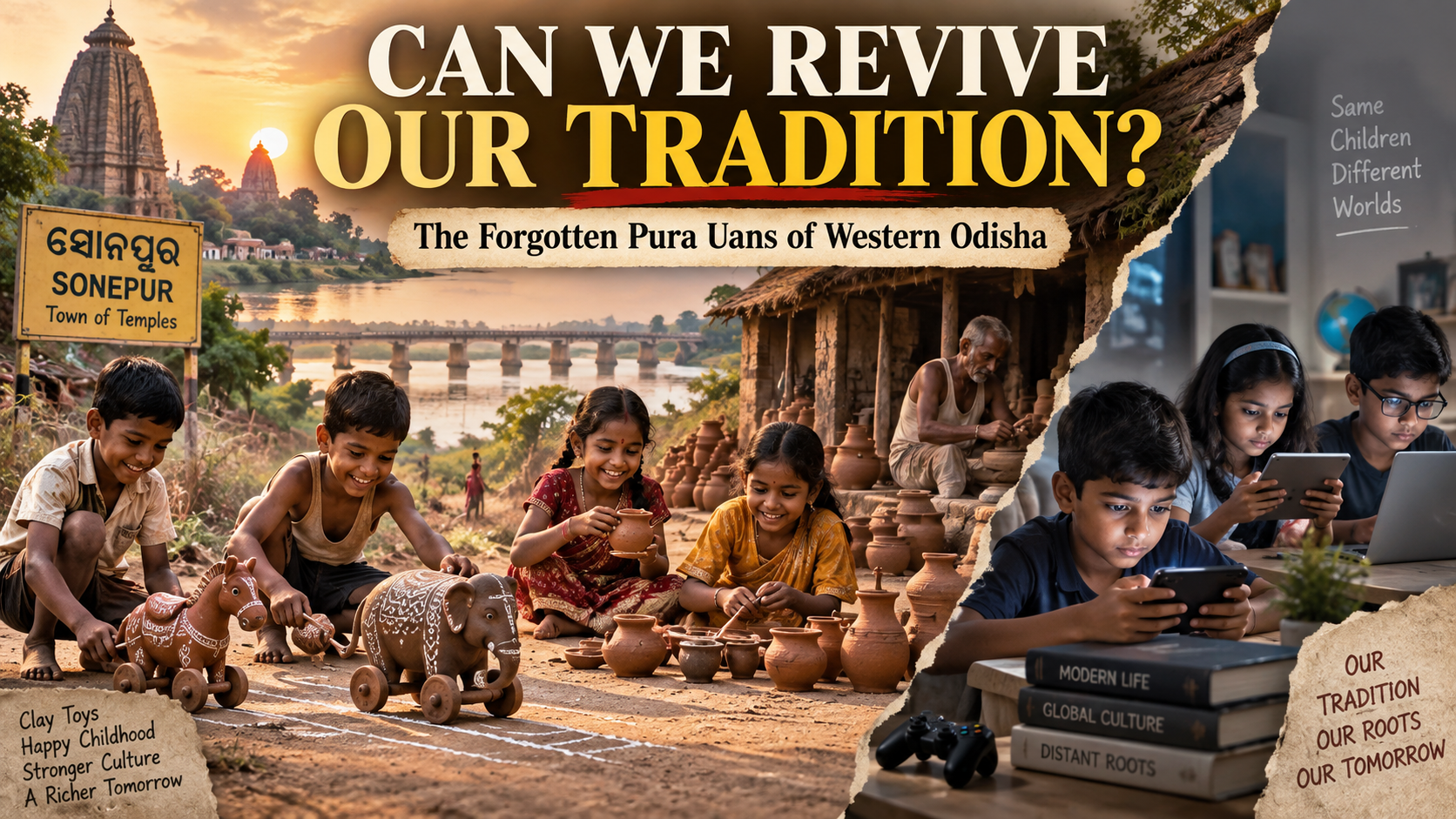
We were at the primary school level. Every year, we waited for Ganesh Puja, Saraswati Puja, 15th August, 26th January and, last but not least, Pura Uans or Saptapuri Amabasya. On the occasion of Pura Uans, girls played with clay pots and we boys played with clay horses and elephants. Our joys knew no bounds. We drew clay horses and elephants in the streets, and the sound of the toys with wheels was very interesting. Girls played with clay pots as a kitchen set and prepared artificial food and served it to us.
We enjoyed the day like anything. We drew not only clay but also wooden toys and tried to preserve the same for the next year. But the toys did not survive for so long because every day was Pura Uans for us, and we drew the same whenever we were free. So we waited for the next year to be provided with new toys by our parents.
Pura Uans or Saptapuri Amabasya has great cultural significance in Sonepur, Kalahandi and other parts of western Odisha. Girls playing with clay pots shows their inclination towards household chores, and boys playing with clay horses and elephants shows their interest in adventure. A delicacy called Saptapuri, containing seven layers of stuffing, is prepared and eaten on the occasion.
Subarnapur, before being a district, was part of Bolangir district, and there was no bridge over the Mahanadi from Sambalpur side. So people from areas like Birmaharajpur, Dharamshala, Ullunda and others on the other side of the Mahanadi had direct links with Sambalpur, as the river formed a barrier to their connectivity with places like Sonepur, Binika and Bolangir. Most of them came to Sambalpur and had even settled down because of the road link.
There were many people from Sonepur side in our locality who spoke about the rich culture and heritage of Sonepur and Binika, along with the tyranny of the rulers. At that time, people from Sonepur and Binika areas could come to Sambalpur only by crossing the Mahanadi. There were large boats called ‘Kushli’, run privately, which could transport even vehicles and bikes.
The clay pots and toys were prepared and sent to the Sambalpur area by the potters of Kumbharpada of Sonepur. The carpenters of Sonepur also prepared wooden toys and sent the same to different places for play by children.
Sonepur, often called the town of temples or second Varanasi, is very rich in culture and heritage. Pura Uans or Saptapuri Amabasya is celebrated with great pomp and splendour. On the occasion, another event takes place, i.e. the Lankapodi Yatra. The potters of Sonepur prepare small statues of Hanuman with wheels. Children drag them after setting fire to their tails and discard or break them. This commemorates Hanuman’s burning of Ravan’s Lanka.
The Lankapodi Yatra is an age-old tradition in Sonepur. The tradition of Hanuman’s tail being set on fire, the Lankeswari Temple, the sprawling Mahanadi, the mound of Asurgarh nearby and certain other monuments have led certain historians in the past to compare Ravan’s Lanka with the present-day Sonepur. Whatever may be the historical basis behind the theory, it is good that Sonepur has kept up the tradition of Lankapodi Yatra and Pura Uans or Saptapuri Amabasya.
In the meantime, years have rolled on. Our childhood days have become a thing of the past. But memory lingers, and I fondly remember my interest and involvement with the festival of Pura Uans. It is unfortunate that it is withering away gradually from our tradition. Today, I hardly see any boy or girl playing with the clay pots and toys.
Though Lankapodi Yatra and Pura Uans in Sonepur and Pura Uans in the Kalahandi area may have survived, it is losing its importance in other parts of western Odisha. Now, let’s analyse the reasons and try to find out the probable solutions:
1) Passing away of elderly people
When my mother, grandmother and their contemporaries lived, the atmosphere was different. They remembered the date and tithi of festivals and accordingly prepared children and others mentally for the occasion. But after their passing away, there is nobody to provide guidance.
The elderly people will never be available again for the same. It is up to the present generation to emulate them and follow our tradition.
2) Decline of family profession
Decline of family profession is also a main reason for the loss of popularity of our festivals. If the potters of Sonepur stop making the clay pots and toys, it will definitely tell upon the future of Pura Uans unless and until potters of other areas take interest in it.
Though it is difficult for the present generation to stick to the family profession after higher education and entering service, yet those members available in the family should stick to it, if not full-time, at least part-time.
3) Disinterest of the present generation
The present generation does not seem to be interested in tradition because of lack of time in their busy schedule, service away from their local place, interest in other matters, etc.
Unless and until the present generation takes interest in it, the situation will further degrade.
4) Impact of western culture
Western culture has always had an impact on Indian culture and tradition. This has distanced the people from their roots. Western ideas, ways of living and thinking have brought about disinterest in local culture and tradition.
There may be no harm in getting influenced by an alien culture as long as it does not affect the local one.
5) Disintegration of the joint family
The joint family brought about unity in Indian society and bound the family members in a bond. The younger members learnt things from their seniors and obeyed them. The family used to celebrate festivals together.
But disintegration of the joint family has put an end to all this.
Though it is difficult now to stop the process of disintegration, yet the branched-off family members can maintain the spirit if they so like.
6) Moving to distant places for jobs
Moving to distant places has kept the new generation away from our culture and tradition. Children born and brought up in distant places can hardly get the opportunity of becoming familiar with their indigenous fairs and festivals.
It is also very difficult to stop the trend of moving to distant places for jobs. But the new generation can maintain the tradition with interest and efforts.
7) Rural-to-urban movement
There has been a rise in the rural-to-urban movement of people after independence. This has kept them away from the rural agrarian culture which shows the real India. The joint family was also predominant in rural areas, which enlivened our festivals.
Development of agriculture and rural infrastructure, along with availability of facilities, may stop the process of movement.
8) New tools for children
We children were really handicapped during our time. We did not have the mobile set and computer with us. We had, therefore, an attraction for the traditional toys.
I remember having played with the clay and wooden toys brought from Sonepur. The present-day tools have distracted the attention of children from the traditional toys.
The present generation has to imbue their children with a traditional spirit.
9) Extreme materialism
Today, man has become extremely materialistic and is thinking only in terms of money and property. He has no time for traditional values.
Though it is difficult to stop man from becoming materialistic, yet he should find time for our culture and tradition.
10) Disrespect for tradition
Man has obviously developed a disrespect for tradition under the influence of materialism, modernism and western ideology. Tradition may appear to be old-fashioned to him. He may very well question as to why his children will draw the toys in the streets. What purpose does it serve?
The present-day man should stick to his roots and have respect for tradition.
India is an ancient land with a rich heritage, culture and tradition. It is because of this reason that it is unique in the world and second to none. Minus the tradition, India would lose its uniqueness. It is therefore imperative on the part of the present generation to stick to the roots and preserve our culture and tradition for posterity.
he views expressed are the writer’s own)
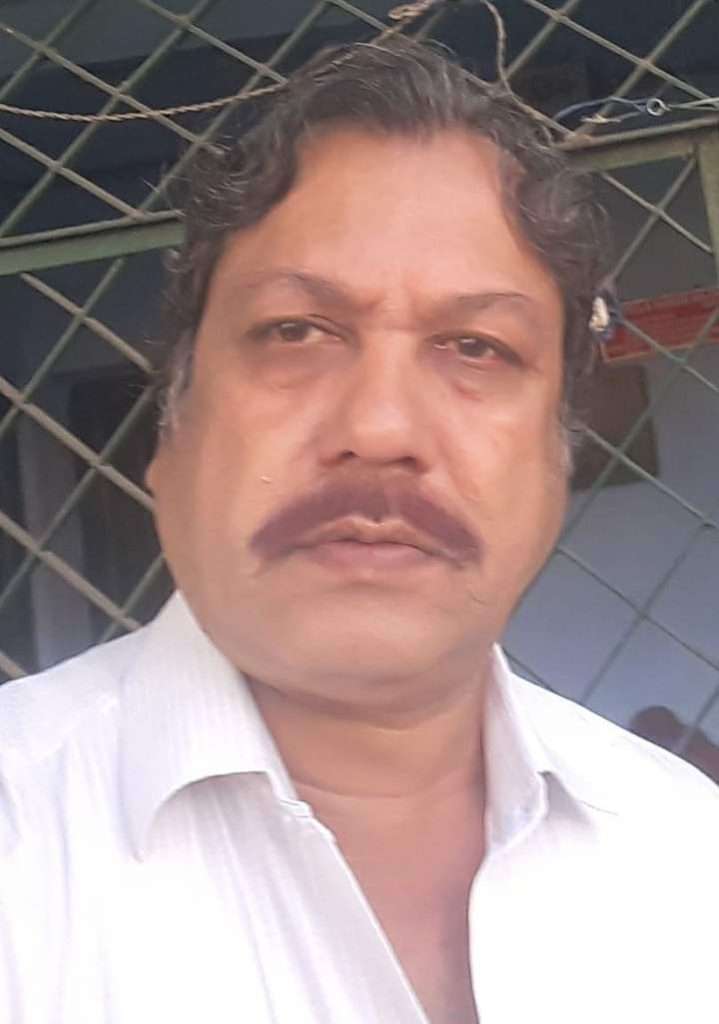
Mr. Prafulla Kumar Majhi,
Retired Asst. Director, A. I. R, is an eminent Scholar and freelance writer in English & Odia. His areas of interests are sociocultural, economic, literary, historical and analytical studies and writings.
Email: airprafulla61@gmail.com
Mobile.9861007190