

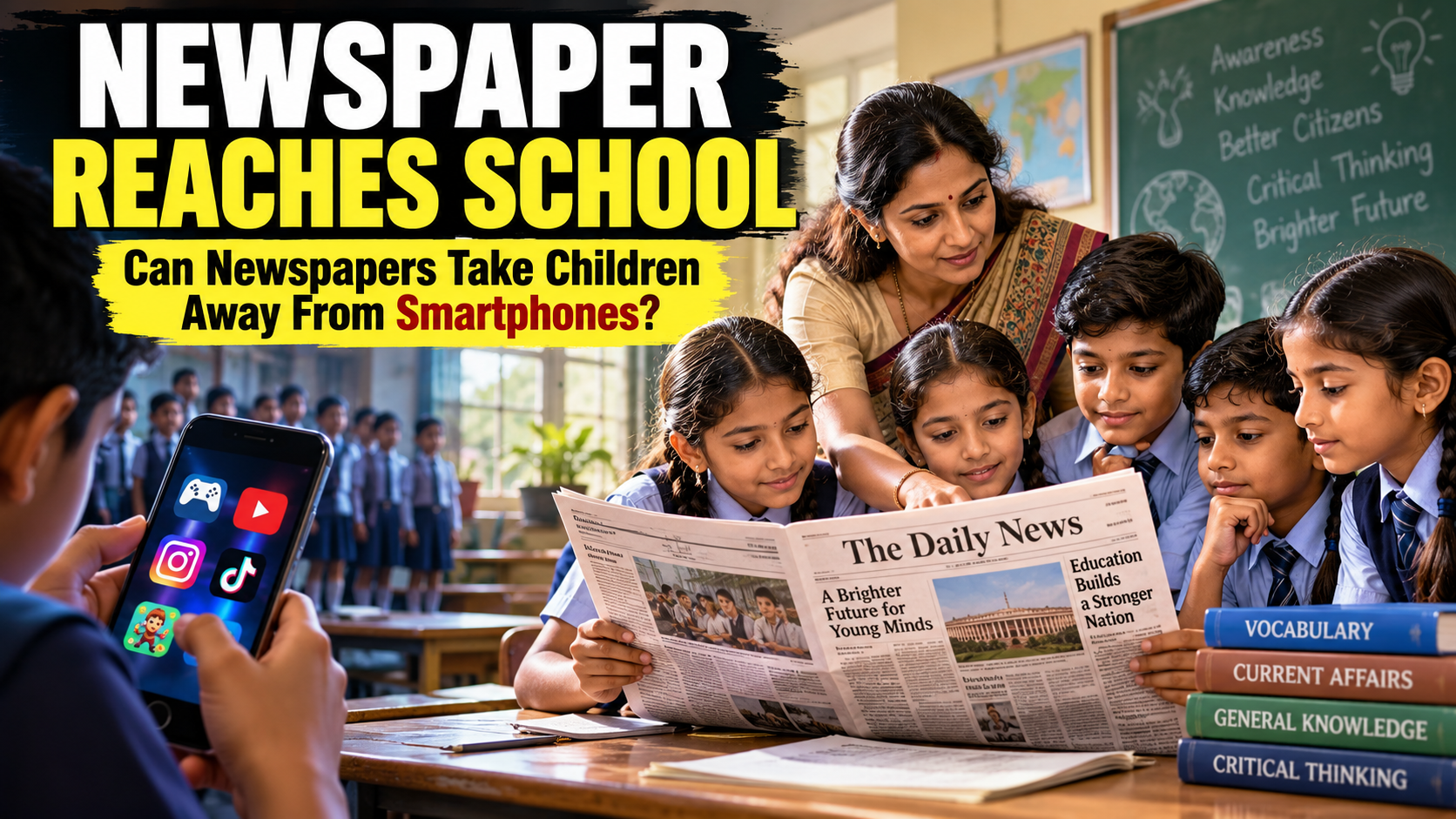
Some months ago, the Government of Uttar Pradesh made reading newspapers compulsory in government primary and secondary schools. The morning assembly must include ten minutes for newspaper reading. Schools must subscribe to reputed Hindi and English newspapers and take the necessary steps to ensure that children have easy access to them. Soon, the Government of Rajasthan made newspaper reading mandatory in primary schools, and soon after, the Government of Karnataka made reading Kannada newspapers obligatory in primary schools.
Newspaper reading is expected to develop critical thinking, a reading culture, and general awareness. It will make children more informed and more sensitive to social problems. Very importantly, it is hoped that it will take children away from mobile phones. Reading newspapers will help children increase their vocabulary and develop a reading habit, which will help them in many ways in the future, including preparing for competitive examinations. It will take at least three to four years after implementation to have some idea about the success of this initiative. However, we can consider the motivations and the realistic possibilities of the objectives.
The initiative reflects the concerned State Governments’ recognition that smartphone overload is a serious problem, especially for children. Australia, France, Portugal, Spain, Greece, and the UK have denied children access to smartphones. In contrast to the stick approach, Singapore has adopted a carrot approach. It has not denied children access to smartphones; it has given them the incentive of a little money to spend fifteen minutes a day reading books. India has not taken any measure in this respect. In view of this, the affirmative step taken by the three states deserves commendation.
Now, newspaper reading may be beneficial in many ways, but one wonders if newspapers can really wean a child off the smartphone. It is too weak to do so. It may be appreciated that children do not look for information on smartphones; they play games. So, newspapers or, for that matter, any reading material, can hardly offer an alternative to the smartphone. In any case, legal and administrative measures are necessary to deny children access to the screen. Common sense might suggest that, supported by the newspaper, they have a better chance of success than either administrative measures or the newspaper. One might ask why the newspaper and not the children’s stories, which would be far more appealing to the children. The answer is that the newspaper informs them about real-world happenings.
The digital world and the imaginative world are both escapes from reality. They have their place in life, but people still have to live in the real world.
However, for children, newspaper reading must be guided. The teacher has a very important role in this. At that stage, mere exposure to newspaper language cannot increase the child’s vocabulary. The teacher must choose appropriate words from the newspapers, explain their meaning and use to the children, and design interesting vocabulary exercises around them. This would give learners useful practice, and the words would eventually become part of their vocabulary.
Content is the real issue; the teacher must decide what to tell children from the newspaper and what to ask them to read. And it is no easy task. Newspapers are for adults. There are no newspapers for primary school children, just as there are stories for children. Little in a newspaper, in English or the children’s mother language, relates to children. They cannot relate, for example, to news about President Trump’s rejection of Iran’s peace proposals or the Indian Prime Minister’s meeting with the Russian President. Children from Odisha or Chhattisgarh do not relate to news about the dispute between Odisha and Chhattisgarh over the Mahanadi River.
The teacher should rewrite the material of his choice for the children and present it to the learners. But this content cannot be presented and explained in ten minutes. We must note that this would be only a substitute for the newspaper. It might inform children about what is happening around them, but it cannot motivate them to read the newspaper.
In this connection, we may mention that Central Government schools have a long-standing practice of students reading out the headlines of a couple of newspapers during the morning assembly. But it has no impact; after the morning assembly, no one remembers, neither the students, even at the secondary level, nor the teachers. News is not discussed in the classroom. These schools have a library, but there is no library hour when the teacher could return to the headlines read out in the morning assembly and explicate at least some of them in some detail.
In sum, there is understandable scepticism about the newspaper reading scheme meeting its objectives.
Newspaper reading would be useful at the higher secondary stage. By then, students are introduced to the wider world through geography and social sciences. They can understand that local problems could be caused by things happening elsewhere. For example, they can understand that the non-availability of cooking gas at home is due to a war between the US and Iran, and untimely floods are due to climate change, which has non-local origins. But in this, the teacher’s guidance is necessary. He would interpret the news and make them see the connections between actions and events. Imaginative interactive sessions would help students develop critical thinking. But this cannot be done in a large assembly in ten or fifteen minutes. It is a classroom activity. An hour, maybe twice a week, must be allotted in the class routine not merely to reading but to studying newspapers and discussing selected content. Newspapers, with their variety of topics and discourses such as news reports, opinion columns, editorials, etc., can help students understand the world better than other reading materials.
(The views expressed are the writer’s own)

Prof. B.N.Patnaik
Retd. Professor of Linguistics and English, IIT Kanpur
Email: bn.patnaik@gmail.com
(Images from the net)