

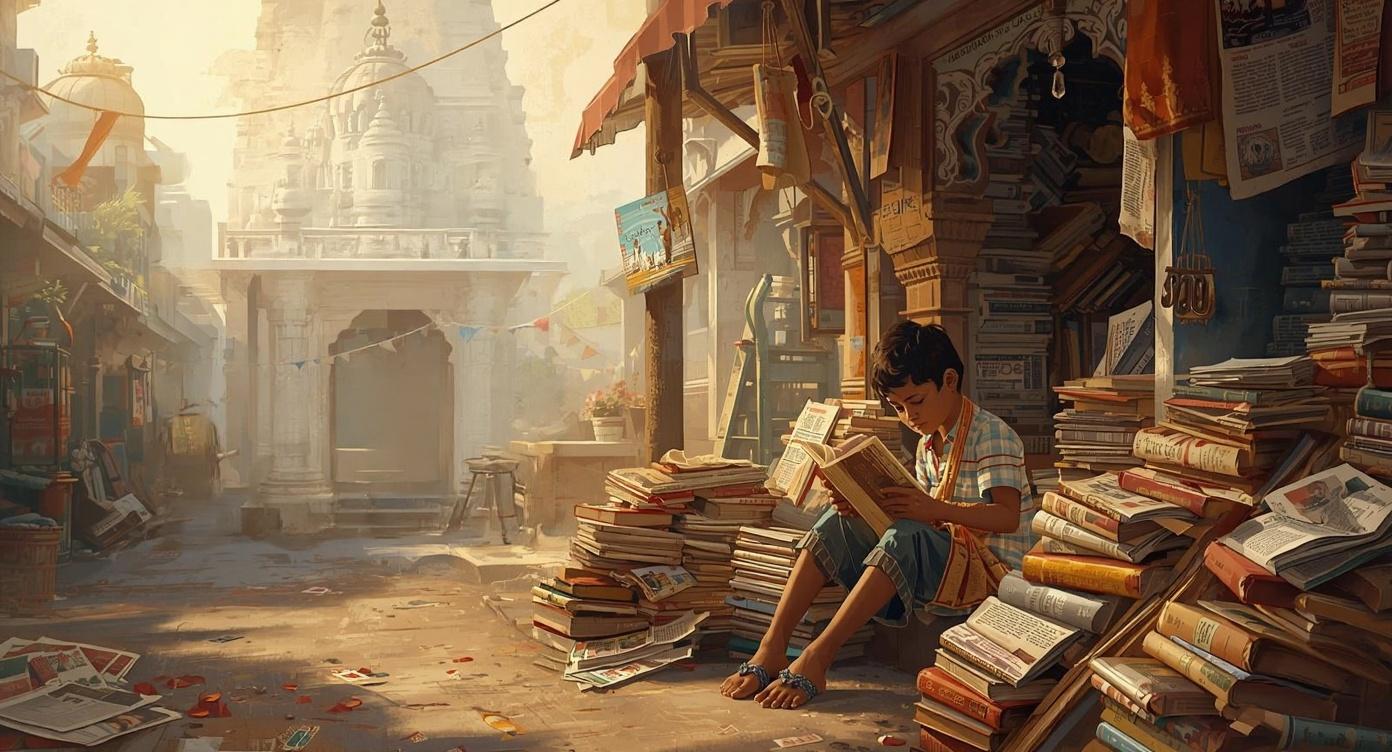
I was born and brought up in a village adjacent to the city of Sambalpur which, in the course of time, has become a part of the city. The village, with two temples and one mutt around, did boast of a spiritual atmosphere with the additional local festivals. There were recitations from the Ramayana, Mahabharata, and the Geeta in the local Gopaljee temple which attracted the village women who gathered to listen to the same. Though we children could not understand anything from the recitations, this definitely exerted a profound influence on our minds and drew our attention to the two great epics of our country to the extent that by the time we reached 7th standard most of us had already possessed the Ramayana and the Mahabharata written by Chakravorty Rajagopalachari. Even today I remember the yellowish cover of the two books and the content in them. At this stage of our life, when we were entering our High School education, such books were of great help in furthering our knowledge and IQ.
While in High School, I remember having heard one of our school teachers saying, “For the students, if the textbooks are like rice, other books will be like dal and curry.” Since then, I have always followed his advice. At that time, the general impression amongst our guardians was that students should concentrate on textbooks only and that it was only a waste of time if they devoted time to other or outside books. This way, they were making their children bookworms. Advice tendered by our school teacher went a long way with us and we were always on the lookout for books outside the syllabus.
At that time, the tradition of book fairs or ‘pustak mela’ had not yet started, at least in cities like Sambalpur. The city had also not yet developed the way it is today. But there was no dearth of books and magazines. By books, I mean books not prescribed in the syllabus and which we read for our knowledge and entertainment. There were very good bookstores, mostly in the Golebazar area, where we got masterpieces to read. There were also small bookstores here and there where we got detectives and novels. These were written by well-established writers and sold like hot cakes. I remember detective series like Meera, Deepak, and Robin. Though we did not learn much from such books, yet they added to our continuous interest in reading and knowing many things about the world. During this time, books and novels of a very cheap nature were available which were the cynosure of most guardians. Even the titles of such novels were made catchy to attract the attention of the readers. Such books were not suitable for children, and we tried our level best to avoid the same and never even brought these home to escape scolding and even thrashing by our parents.
There were numerous stalls for magazines and newspapers in different parts of the city, particularly in the old bus stand area and the Khetrajpur railway station. There were magazines for children like Champak, Chandamama, Mo Desha, Manapabana, Gourava, Shishulekha, Chhatrasathi, and others for which we had to go to the stalls again and again. These magazines were really useful for children with their material and pictorial content. There were other categories of magazines like Filmfare, Star & Style, Screen, Picturepost, Sportsstar, Sportsworld, and others which delighted us since we were in a formative stage of learning English. Though we did not bring film magazines home lest our parents should object to it, yet we can hardly ignore their contribution to our learning English. On holidays and even after school hours, we made rounds of these stalls for our favourite magazines. The children’s magazines took special care of their content so that children could learn a lot. Chandamama and Champak put stress on pictorial quality along with content, and children were automatically drawn towards them.
This interest of ours in books continued from our High School days to the University, which can still be found. It is not that all friends were as voracious readers as some of us were. But almost all understood the importance of books. Some friends did cultivate the habit of reading cheap novels and detectives. But by the time they entered college, this habit of theirs was no more. At that time, book fairs or ‘pustak mela’ had not become as popular as they are today. I cannot comment on their status in big cities like Delhi. But gradually, they have come to cities like Rourkela and Sambalpur via Bhubaneswar, and in recent times other towns and cities like Bolangir and Sonepur have also come into the picture. In times to come, more and more places will be covered by the book fair movement.
Even today, some of our friends have retained the habit of reading books. Till recently, one of my friends sent on WhatsApp a textbook which we studied in class VIII because of its outstanding prose and poetry sections, which I have preserved. Whatever textbooks I have studied from Standard I to the University level were really superb and written by brilliant writers. At the same time, we never missed the opportunity of reading the best of books and masterpieces not prescribed in the syllabus.
Today, Sambalpur has grown to be a bigger city than what it was when we started off as readers of books. The number of bookstores has increased, though temporary ‘thelas’ selling books are not to be seen. I really miss them and extend my heartiest thanks to them for making my childhood and boyhood days enjoyable in the midst of books. The book stalls are still there in the old bus stand and other places. The tradition of selling books in the streets in certain places of the city is still there, which can also be found in cities like Delhi. Today, we have cultivated habits like visiting movies, playing cards, watching television, and sitting in tea and paan shops and gossiping. But reading good books is a habit which should be cultivated by one and all. It is said that even a friend may betray you, but a book can never betray you. A book is definitely the best friend.
Essayist Francis Bacon says that reading makes a complete man. We often quote the Geeta and say, “Go on doing your duty without waiting for the result.” Had it not been enshrined in a book, the saying could not have been in circulation for thousands of years. So next time, whenever there is an opportunity to read a good book, we should not miss it. We should never say that we do not have the time for it or to visit a book fair. These days, book fairs are coming up with the rarest of books. Keeping in view the importance of books, we should cultivate the habit of reading and never say ‘No’ to a good book.
(The views expressed are the writer’s own)
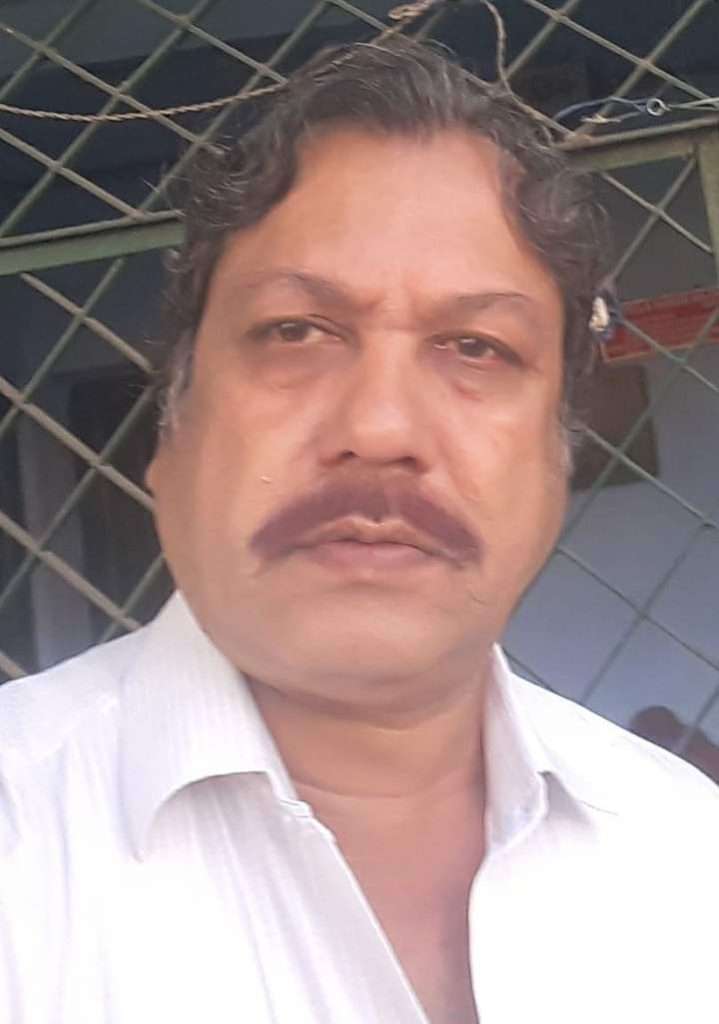
Mr. Prafulla Kumar Majhi,
Retired Asst. Director, A. I. R, is an eminent Scholar and freelance writer in English & Odia. His areas of interests are sociocultural, economic, literary, historical and analytical studies and writings.
Email: airprafulla61@gmail.com
Mobile.9861007190