

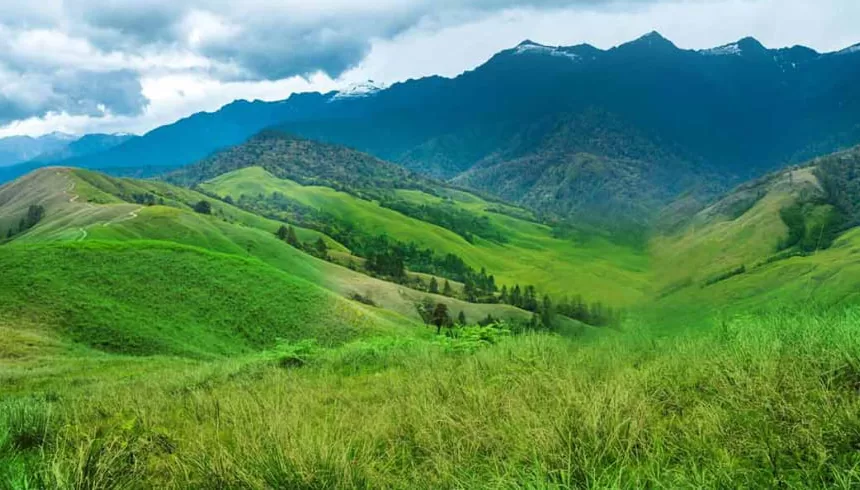
Barak Valley is a region in South Assam. It comprises the districts of Cachar, Karimganj, and Hailakandi. Silchar is the main cultural centre. This valley is named after the Barak River. Barak Valley is well known for tea cultivation, rich biodiversity, and Bengali-centric cultural heritage. This valley shares borders with Meghalaya, Mizoram, Manipur, Tripura, and Bangladesh. This valley comprises about 9% of the state’s area. It has lush greenery and fertile lands. The economy relies on tea cultivation. The main language is Bengali. The major town is Silchar. The region gets significant rainfall. It is connected to the rest of India via rail and road. The Barak River system has dolphins.
The name Barak is derived from two words — Bra and Kro. Bra means bifurcation, and Kro means upper portion/stream. The Barak River is bifurcated near Haritikar in the Karimganj district into the Surma River and the Kushiyara River.
Inscriptions tell that in the 10th century, the region around the Surma and Kushiyara formed frontier settlements called Srihatta and Khanda Kamarupa, established by Kamarupa kings in the seventh century. In 1787, the Brahmaputra changed its course to meet the Meghna a hundred miles farther south. This affected the Surma-Kushiyara basin during floods.
The three districts of the Barak Valley have their own historical origins. It was a by-product of the colonial empire-building under the East India Company and the British Raj. The pre-colonial kingdoms were not cartographically defined. They were defined according to heartlands and the defense of the margins.
The East India Company got into the revenue farming and judiciary business with the Diwani Grant of 1765. The company developed a keen interest in monopolizing traditional trade routes and expanding settled farming for revenue. Assam’s Surma Valley had a Muslim-majority population.
Durga Puja is one of the major festivals of Barak Valley. Busu Dima is an annual cultural festival celebrated by the Dimasa Kachari tribe of North Cachar Hills and Cachar of Barak Valley. It is a harvesting agricultural festival. The festival is normally organized in the month of January.
Bishsu is a traditional festival of the indigenous Dimasa Kachari tribe of North Cachar Hills and Cachar. It is celebrated just after Busu Dima. The traditional dance continues for a week. Locals organize cultural events, public meetings, rallies, and various programmes.
Charak Puja is associated with the Bengali New Year. Poila Baisakh, as it is called in the local language, falls on April 15. Eid is also a major festival, as Muslims constitute half of the valley’s population.
Barail is the only wildlife sanctuary of the Barak Valley. It was initiated by the naturalist Anwaruddin Choudhury in the 1980s.
On the whole, Barak Valley is a natural region in the Northeast. Its lush green area is a gift of nature. Its tea gardens give us enough tea in the morning, making it a good morning.
(The views expressed are the writer’s own.)
Radhakanta Seth is a Former Income tax officer in Sambalpur. He is a Freelance writer and his articles have been published in some Oriya dailies like Sambad, Samaj, Dharitri and English dailies like The Telegraph and in a sociological journal ‘Folklore’ published from Kolkata.
(Photo has collected from net )