

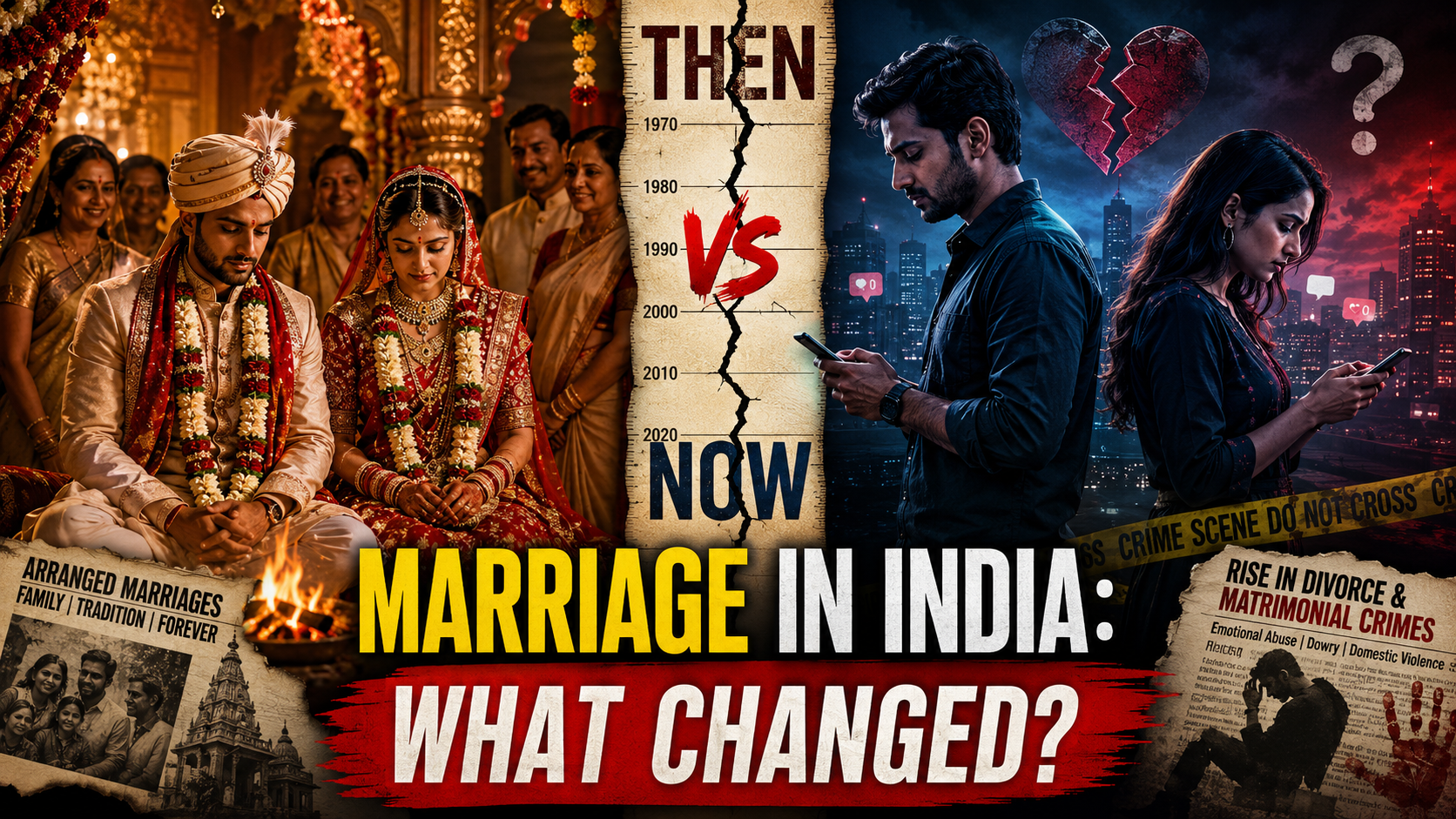
Thirty to thirty-five years back, searching for a bride or groom for matrimony was not very difficult or complicated. It did take time to search for the right candidate, but there was hardly any other complicacy in the process.
In urban areas, girls crossing the age of 20–22 years became a matter of concern, and in rural areas, the ceiling was reduced to even below 20 years. Girls were considered to be ripe for marriage as per practices in communities also. As far as boys were concerned, the limit was 24–25 years, and if somebody crossed 28–29 years, it was too much. The reasons are not far to seek. Girls, on completion of their BA or MA, stayed at home and almost waited for marriage.
Though girls had already started entering the job market, most of them stayed at home. Mothers and grandmothers trained them in household management and taught them the social and traditional rituals. The girls were also mentally ready for a happy married life with a new man in their life, children, and a family to look after. Proposals from families would come, and parents would choose the right groom for their daughter.
Love marriage was almost a taboo. Girls might have loved boys during their school or college days, but they did not want to proceed in the matter and preferred to remain silent. Neither did they interfere with the choice or decision of their parents and preferred to accept their choice, having full faith in them. Even if the grooms were bald or dark-complexioned, they still gave the green signal.
Almost similar was the case with the boys. In urban areas, boys did go in for marriage after getting a job or starting some business. Since, in rural areas, boys either followed the family profession or farming and stayed at home, the limit was 20–22 years on an average. It became a matter of concern, and even people started discussing it when boys crossed 22 years in rural areas and 25 years in urban areas.
Boys also preferred their parents’ choice and went in for an arranged marriage. Compared to girls, boys often prevailed upon their parents in favour of a love marriage. Even in arranged marriages, boys, both in urban and rural areas, were allowed to go and see the bride with a relation or friend. Girls sitting at home and waiting for marriage also got a chance to see their would-be husbands.
The final stage was matching of horoscope or Kundali. If the astrologer found the Kundali of both boy and girl matching, an auspicious date was fixed to solemnize the marriage.
This was the overall marriage scenario thirty to thirty-five years ago and successfully steered the course of the society.
After analysing the marriage scenario thirty to thirty-five years ago, let us have a look at the present scenario. A lot of changes have taken place in the meantime. As India has a traditional and conservative society, the age-old system of marriage is still in vogue. Arranged marriage is the most practised system. Boys visit the bride’s house as decided by their parents and settle down in marriage. Girls do obey their parents.
But the difference is that they want to do a job first and then enter matrimony. A sense of insecurity seems to have developed in the girls. They apprehend as to what the groom would be like and how she will be able to cope up in a new family. They are also thinking in terms of financial security and want to lead a life of independence. It is because of this reason that their age limit for marriage is increasing day by day, and now it is in the 25–30-year age limit.
Moreover, girls want to read and do jobs like boys, and for them, marriage is not the be-all and end-all of life. The system of boys going to see their brides still continues. But some sort of independence has been allowed to both. Talking openly and interviewing each other, going on dates, and talking on mobile have become common even in traditional and conservative families.
Boys and girls have started exercising their options and talking to their parents freely in case they have any choice. It is being seen that boys and girls often choose their life partners during their school and college days and even during their training or service periods. But this type of love marriage is still rare.
In addition to marriage, contract marriage, live-in relations, and open relations have come up in recent times. These formats of relationship may have legal status, but the traditional Indian society is yet to accept them. Parents are also not in favour of the same. Boys and girls are entering such relations either clandestinely or against the wishes of their families.
A comparison of the past with the present is a must, keeping in view a heinous crime like murder, which is taking place at regular intervals with respect to marriage and matrimonial relations. Though the marriage scenario has relaxed a lot, still then why are there so many cases of boys and girls killing each other when marriage is about to be solemnised? Let us try to find out the reasons and probable solutions:
1) Social restrictions—Though a lot of changes have taken place in the marriage system, yet there are social restrictions on it. Marriage is strictly prohibited beyond one’s caste, community, and religion. It is not that the social restrictions are not good. These have been formulated since time immemorial in social interest. It is obvious that since each caste, community, or religion has its own rituals, customs, practices, and traditions, marrying within the same has definitely certain advantages. It is because of this reason that people are sticking to the system and not because of any superstition. Boys and girls should also follow it as far as practicable, though in certain cases it may be difficult. Social restrictions, deep-rooted in the society, will definitely take time to wither away. India has a traditional and conservative society with a special identity in the world.
2) Impact of modernism and western culture—Despite India being a traditional and conservative society, it can hardly avoid the influence of modernism and western culture. The present-day boys and girls are trying to find out a substitute for marriage in open relations, live-in relations, and contract marriage. These relations may have a legal status but lack the social sanctity of marriage. They are also diverting the boys and girls from the institution of marriage, thereby disturbing the harmony of the system. Boys and girls should realise that we are yet to find out the right substitute for marriage. This change in social relations is causing problems amongst the new generation.
3) Extreme materialism of boys and girls—Boys and girls have become extremely materialistic and therefore hesitate to inform parents about their love or interest in marrying somebody, lest they should be deprived of paternal property. In elopement also, they have to lose everything and starve till they make their own arrangements. This often leads them to murder their bride or groom so that they remain united with their lovers. Unless and until boys and girls take the risk of telling their parents or negotiating with them, the problem is not likely to end. The new generation has to discard callousness in their own interest as well as in the interest of others.
4) Attitude of parents—Parents undoubtedly think well of their children and fix candidates for marriage, keeping in view their image, character, and family background. They may also commit mistakes unknowingly. But it is seen that because of their experience, they take right decisions, and arranged marriages have mostly been successful through the ages. But while doing so, they are oblivious of what their children want. Knowingly or unknowingly, they ignore the choices of their children, and this tendency is creating the problem at present. The generation gap between parents and children, with their respective thinking and ideology, has also widened the gap between the two. Development of independent thinking on the part of the new generation is responsible for the communication problem between the two.
5) Arrogance of people and disobedience to Law and Authority—People seem to have become arrogant and disobedient to law and authority. This was something rare in monarchy and dictatorship. In democracy, absolute freedom has had a psychological impact on the minds of the people. They think that law and authority can do no harm to them. It is true that proper investigation and production of evidence are a must to prove the guilt of a criminal. Sometimes it may not be possible due to various reasons. But this does not mean that the system is weak and criminals may easily escape.
6) Staying away from values—Staying away from values is one of the main reasons for the present-day problems in the society. What our forefathers have envisioned in the past is not necessarily bad for us. Marriage is a case in point. But if it is considered to be a bondage, and in its place open and live-in relations are accepted, what can be done about it? Excessive freedom in democracy has made people more and more crazy for freedom. India has a traditional society which stands for values. If people stay away from values, the society will definitely become wayward, thereby leading to further crimes.
The scenario has undergone a sea change over the years, and the society has become much more relaxed than what it was three or four decades ago. Whatever rigidity is there will gradually wither away. Both the old as well as the new generation must be submissive and understanding. There should be no communication problem between the two. There can be no excuse when an accused girl says that she had to murder her prospective husband with the help of her lover as she did not have the guts to elope due to fear of social ostracism or tell her parents openly about her choice. Nothing can be more ridiculous than this. We are living in a comparatively relaxed society now. An open and free mind and respect for both tradition and law on the part of the new generation will definitely make them stay away from crimes, thereby establishing order in the society.
(The views expressed are the writer’s own)

Mr. Prafulla Kumar Majhi,
Retired Asst. Director, A. I. R, is an eminent Scholar and freelance writer in English & Odia. His areas of interests are sociocultural, economic, literary, historical and analytical studies and writings.
Email: airprafulla61@gmail.com
Mobile.9861007190