

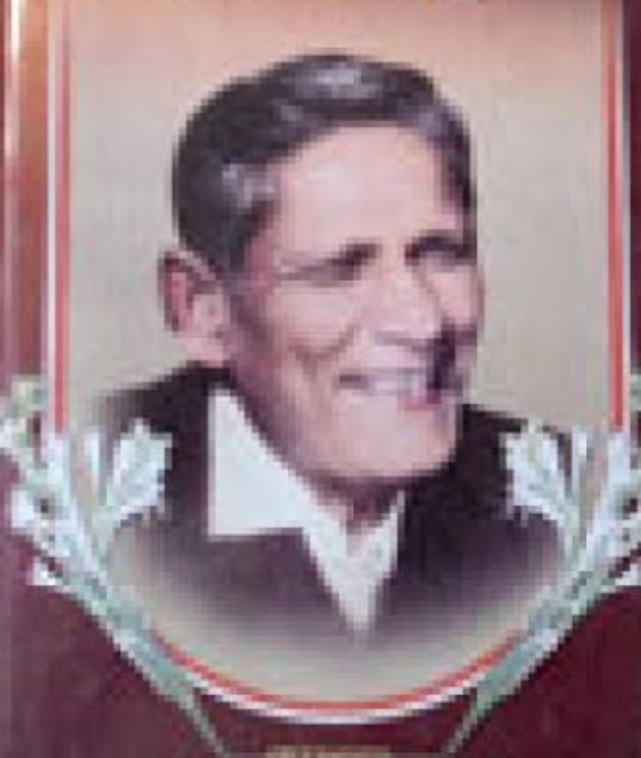
The caption of this article might raise the eye brows of literary lovers across Kalahandi in particular and Odisha in general in view of the fact that Late Prafulla Kumar Rath(1935-2006) is being honoured and adored more as a playwright than a novelist.What substantiates such a notion is the overwhelming discussions, deliberations and presentations on him as playwright, not as novelist at various academic and literary platforms with magnitude and magnificence over the years, even during his life time and aftermath. The notion assumes more reinforcement from his name that begins with the designation “Natya Rashmi”, rendering literary as “Ray of drama”. What’s more, Odisha Sangeeta Nataka Academy, Bhubaneswar conferred its highest honour “Kabi Samrat Upendra Bhanja award” upon him in 1996-97 on the basis of his dramatic accomplishment. Naturally, one would hardly be aware of his creative world that does not confine to drama but stretches to novels, short stories, essays, autobiography and translation. To our pleasant surprise, he happens to be a Odia novelist of par excellence. It wouldn’t be superfluous to designate him, as per the literary sources available till date, as the first ever detective novelist of Kalahandi, keeping in view the bulk of his novels based on detective, mysterious and thrilling stuffs.
Such an illustrious literary figure not only of Kalahandi but also Odisha was born on 17.02.1935 at Khutuluguda, a remote village under Koksara Block of Kalahandi district. The ebb and flow of time brought him to Bhawanipatna, the district head quarter of Kalahandi where he turned out to be a teacher by profession and a writer by passion. “Braja Mohan Sahitya Samiti” (1945) and Natya Sanstha functioning under the patronage of the then king of Kalahandi, Maharaja Pratap Keshari Deo lent him a conducive literary environment to rear and nurture his fledgling talent that matured in due course of time to earn him the prefix to his name-‘Natya Rashmi’, a designation conferred upon him in recognition to his dramatic accomplishment in 1972 by Braja Mohan Sahitya Samiti, Bhawanipatna.
By the time Late Rath resolved to write Odia novels, a new trend in the same genre was in progression in the wake of the impact of World War-II, India’s Independence, changing life style during post Independence, fast Industrialization, scientific progress and increasing westernization. Thus in his book entitled “Kalahandi ra Sahitya Baibhava”, Dr. (Prof.) Dasharathi Acharya, the celebrated essayist and critic writes-
“During 60s and 70s Odia novels, instead of narrating a story in traditional way adopted many a new technique, style and experiment based on various theories, Philosophies, problems and predicaments that the then society had been confronting with (page-36, 37)”.
In such an ambience, detective novel was mustering momentum of popularity among the readers visa-a-visa the traditional novels being flourished amply by the then celebrated Odia writers- Kanhu Charan Mohanty, Gopinath Mohanty, Dr. Hare Krushna Mahatab, Mahapatra Nila Mani Sahu, Krushna Prasad Mishra, Santanu Kumar Acharya, Bibhuti Pattnaik and others.
During the post World War-II, a group of Indian writers were inspired by the mystery, fantasy and thrilling based writings of American poet, critic and writer, Edgar Allan Poe, the pioneer of modern detective story, which in turn cemented a foundation for detective novels in India and Odisha as well. To our pleasure, Odia writers were not lagging behind. Quite surprisingly, by 1970, this genre of literature, being viable on business point of view, had erected a mammoth assembly of readers across the length and breadth of Odisha. Consequently, there came into being Odia detective stories and novels spearheaded by some celebrated writers like Chandra Mani Das, Dwarikanath Das, Kanduri Charan Das, Jogendra Ku. Mohanty, Jameshwar Tripathy, Sanat Kumar Mahapatra and so on. In Kalahandi, Natya Rashmi Prafulla Kumar Rath, apart from writing social and historical novels, upheld the trend of writing Odia detective novels that culminated with his immortal works on detective series-“Junglee series, Rahasya Series and Kalabazar series.
It is no less than an uphill task to make a list of total novels written by Rath. In this context Dr. Dasharathi Acharya, the reputed essayist and literary critic writes in his book entitled “Kalahandi ra Sahitya Baibhava”-
“During my direct discussion with Mr. Ratha in 1991, I came to know that Mr. Ratha had written more than 40 Odia novels (most of them are detective). Some of them have already been published and some have not. Unfortunately, his house caught fire on 17.04.1989 and several manuscripts of his works including that of novels had been turned into ashes (page-37, 38)”.
Nevertheless, prior to the preface in his novel ‘Naree Ra Artanada’ published in 1966,late Rath had mentioned about following novels written by him under the title: ‘Ae Lekkhaka nka au ketoti bahi (Some other books written by this writer)’
JUNGLEE SERIES:
- Junglee, (2) Jungla re ManishaRakta, (3) Junglee Raja Mruganka, (4) Mruganka diary, (5) Jungala ra Sasha Rahasya, (6) Mati tale Junglee.
RAHASYA SERIES:
(1) Neela banare khun, (2) Khaian Ki ae Sadajantra, (3) Wrong Number
KALABAZAR SERIES :
(1) Naree ra Artanada, (2) Ratri o Nisha
However, as the following four novels are available to me, I may be bold enough, on their basis, to analyse Late Rath’s contributions to the growth of Odia literature.
(i) SWAPNILA DUNIYA (1962)
Swapnila Duniya published in 1962 happens to be a fictitious novel with a blend of mystery and thrills. The protagonist, Kishor exhibiting rare valour and bravery rescued the princess Manjarika of Ratnapur twice; once while she was being kidnapped by king of Chandragada, Chandrabhanu and the other time while she was being attempted to be raped by Dewan Chandi Malla and bailiff, Chhotulal.By the turn of events, Chandi Malla got Kishor imprisoned on the basis of his fabricated allegations that Kishor had illegitimate relationship with the princess. Eventually, while Kishor was being taken as a sacrifice to Chandi temple, Jhemala, lady-in-attendance to the princess and Shyam Lal, friend of Kishor rescued Kishor by dint of their rare bravery. The outrageous Dewan, in retaliation, set the house of Kishor on fire. However, as the fire about to devour Kishor’s mother, Malati, she threw down the magicwand kept by Kishor, which caused the appearance of demon Chando all of a sudden. The demon rescued Malati from fire and even helped Kishor and Shyam Lal marry the princess and her lady-in-attendance respectively.
The novelist wonderfully knitted apt words, expressions and situations in juxtaposition to delineate the adventure, heroism and passionately loving pursuit of Shyam Lal, the protagonist for making the novel no less than a thriller. Intelligent incorporation of folk tales to the novel makes it unique.
‘Virtue triumphs over vice’ is the message of the novel. The dream of Shyam Lal while sleeping on a bench of Crowded Railway station forms the story of the novel. As such, the title of the story is apt and justified.
(ii) NAREE RA ARTANADA (1966)
The detective novel, ‘Naree Ra Artanada’, published in 1966 was included in the first part of Kala Bazar series. The novel highlights the degeneration of India’s political and social structures soon after the Independence and commitment of some educated, ideal and duty bound youths, though merger in number, to restore virtue, veracity and human values.
The protagonist, Prashant, an ideal and highly educated young man was two times president of Ravenshaw college had to leave Bhawanipatna for raising voice against social injustice, exploitations and tortures. He had no option but to stay in hotel ‘Public choice’ at Cuttack.Quite coincidentally, he came upon his class mate, now a police officer, Jayant who had come there to probe into the suicidal case of Chandana. Later, by the turn of events, he met Annapurna, a prostitute who told him about the poverty-ridden miserable lives of young girls engagged in prostitution against their will. Even in a strange turn of events, he came upon Chhaya, a friend of deceased Chandana while enjoying together a play at Annapurna Group-A theatre. Eventually, they came back to the hotel together on a rickshaw discussing about the death mystery of Chandana. Strangely enough, the death mystery of Chandana was not revealed till the climax of the novel.
(iii) RATRI O NISHA (1968)
“Ratri o Nisha” published in 1968 is the concluding part of the novel,“Nari ra Artanada”. The death mystery of Chandana and several unsocial and immoral activities have been revealed in this novel through a series of coherently well projected events.
In continuation of the “Nari Ra Artanada”, the novel ‘Ratri O Nisha” begins with the arrival of Chhaya Dutta and Prasanta at the ‘Hotel Public choice’ soon after enjoying a play of Annapurna Group-A theatre. As Prasanta entered the ‘Entertainment Hall’ of the hotel, he was shocked to see men and women in intoxication were performing ball dance in tune with the singing of Chhaya. There he came upon Hare Murari Das, the villain and the black marketers who used to come there for wine and Women.Even Chhaya, a victim of prostitution informed how young girls were trapped by so-called business men like Hari Murari Das.
Eventually, handing over the evil characters to the Police, the novelist has brought out the poetic justice at the culmination of the novel.
‘Down fall of demonic power and rise of human consciousness’ is the inner voice of kalabazar series. The justification of title ‘Naree Ra Artanada’ lies in the fact that the story deals with using women as a means of physical pleasure and earning money and compelling them to commit suicide like Chandana in case they oppose such injustice to them. Likewise, the so-called civilized men resorting to savage activities out of intoxication at night forms the story of the novel ‘Ratri O Nisha’. Hence the title is justified.
(iv) GHURNI BATYA (1983)
Though Late Rath had finished writing his social novel, ‘Ghurni batya’ by 1966,but it was published in 1983.Through this novel, the playwright throws light on recklessly the passionate love between young men and young women during their youthful days and their consequent failure to marry each other leading to disaster in their respective future family and conjugal life.
Sarani loved Nirmalendu passionately, but got married, by turn of events, to Rama Kanta, Deputy Collector and class mate of her lover. Later Rama Kanta came to know about the bygone love affairs between his wife, Sarani and his class mate Nirmalendu. subsequently, pretending to have been committed suicide, Rama Kanta lived the life of a saint, Siddha Baba. As the event has its own turn, the widow Sarani rendering the job of a nurse at Khutuluguda village chanced to serve the ailing Nirmalendu. As soon as Nirmalendu came round, ‘Janaseva Sadan’ was set up at the direction of the Siddha Baba to serve the people. Madan, while attempting to seduce Sarani was caught red-handed by his father. Out of shamelessness, he committed suicide not before donating all his money and properties to Janaseva Sadan. At the suggestion of the Siddha Baba, the Janaseva Sadan was renamed as Madana Seva Sadana. Since then Madan Seva Sadan had been rendering service for the cause of humanity.
The aforementioned novels manifest Late Rath’s deep insight in studying the men and manners of human society in a microscopic eye.Through the same novels,his projection and presentation of various characters amid their latent problems, predicaments, suffering, corruptions and vices in their own situations like a portrait and offering them laudable solutions are quite universally representative.Moreover,the forward movement of the novels to culminate with poetic justice and a sense of optimism has turned out to be the hallmark of Late Rath’s creative world.
The craftsmanship in Prafulla Ratha’s novels, in tune with the narrative technique till 70s, hardly exhibits any sort of newness or experiments. Obviously, on the basis of a particular background, the main story has been narrated. ln ‘Ghurni Batya’, during the silver jubilee celebration of Madan-Sevasadan, Basanta narrated the story of the novel before Nirmalendu whereas in ‘Swapinala Duniya’, the story is revealed through the statements of Shyamlal before the judge in the court. However, the novels included in Kalabazar series is in exception as the events gradually unfolded the story.
The prose style of Prafulla Rath is quite praiseworthy as it has enriched the craftmanship of the novel. Being the detective novelist, he is successful in speedy progress of the story. At the same time, unlike the social novel, the novelist has hardly focused on deep characterization adhering to the feature of detective stories.
The sense of Satirical attitude towards the weakness and fault of society with an inherent intention of reformation seems to be the aesthetic feature of Late Rath’s novels.As the police arrived pretty late to investigate suicidal case of Chandana, he writes-
“The police have not reached yet. Yes! Police of free India arrive late but for their due preparation” (Nari Ra Artanada, page-24).
Prafulla Rath, as per the contextual needs is lenient enough in using languages other than Odia in his Odia novels. Thus he has not been hesitant at all in using Hindi, Sanskrit, English and in some cases regional languages in the aforesaid novels.
May be the overwhelming success of Late Rath’s plays, being discussed and deliberated time and again at various academic and literary forums and were being staged in innumerable rural villages, towns and cities of Odisha and even their performance by the historic Annapurna group of theatres, Cuttack might have overshadowed the success of Late Ratha as a novelist. Evidently, it is high time on the part of literary lovers, critics and researchers all over Odisha to explore into the avenues of late Rath’s novels to perpetuate the legacy of Odia detective novel in particular.
To sum up precisely Late Natya Rashmi Prafulla Kumar Rath predominantly happens to be a gifted playwright with his plays are active and alive in public domains till date, yet he can be, in no less measure, entitled as a successful novelist particularly of detective genre of Odia literature.
REFERENCES:
1. Acharya, Dr.Dasharathi – (1) Kalahandi Ra Sahitya Baibhava,Publisher:Kalahandi Lekhaka Kala Parishad, Bhawanipatna, 2011
2. Rath, Prafulla Kumar-(2) Swapnila Duniya, Publisher:Bhrati Bhndar, Titilagarh, 1962. (3)Ratri O Nisha, Publisher:Odidha Book Store, Binod Bihari, Cuttack-2,1968.(4)Naree Ra Artanada, Publisher:Odisha Book Store, Binod Bihari, Cuttack-2,1966.(5)Ghurni Batya, Publisher:Pustak Bhandar, Banka Bazar, Cuttack-2,1983
3. Nayak, Adhayapika Labanya-(6) Upanyash Sahitya Samparkare, Publisher: Pustak Bhandar, Berhampur, 1967
4. Forster, E. M-(7) Aspect of Novel, 1927
(The views expressed are the writer’s own)

Bankim Mund
Lecturer in English
Dharmgarh Women’s Jr. College, Dharamgrh, Kalahandi Mob 8327717672
You can reach to him : bankim.mund@gmail.com