

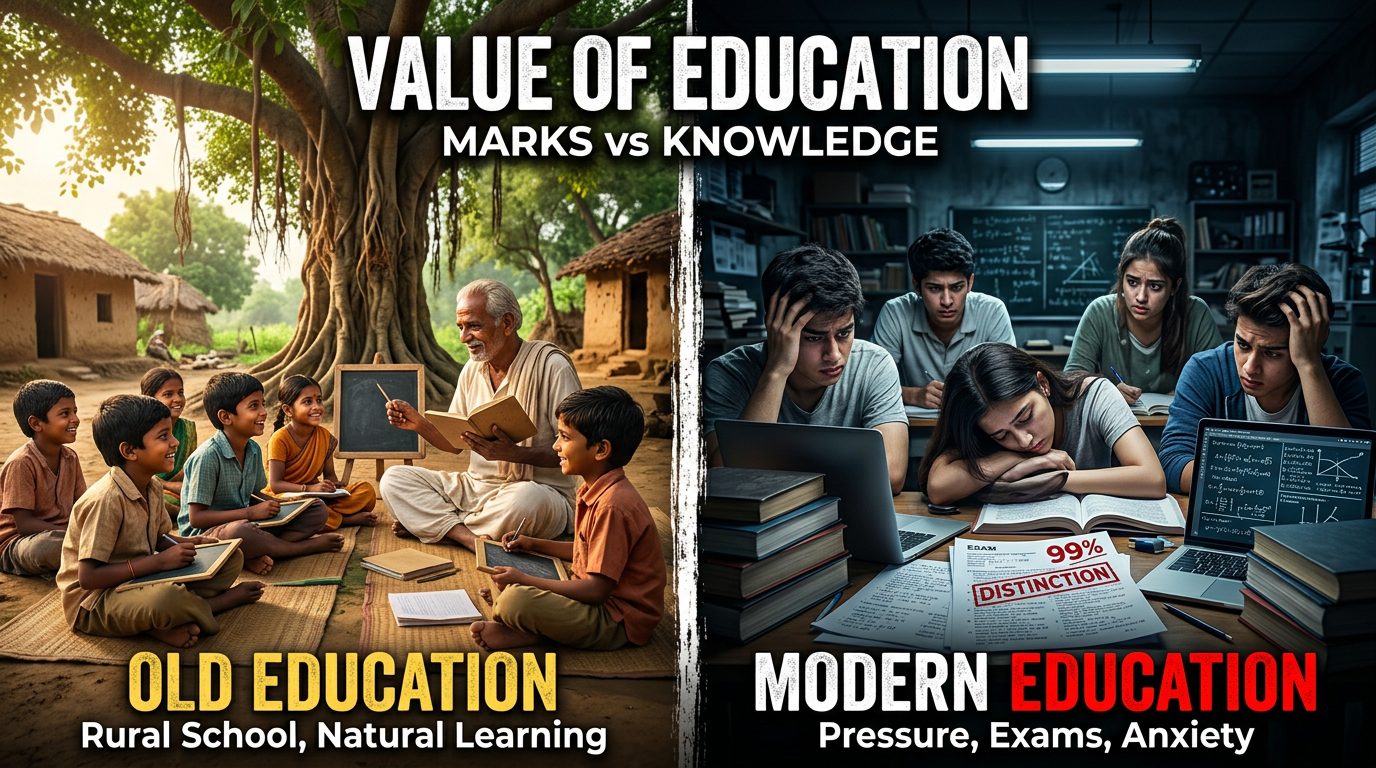
When we were children and in school, there was only one school in our village, being managed by the government and catering to the needs of students up to 5th Standard. Students from nearby villages also came to our school for study. Later, of course, more and more schools have come up, initially till 3rd Standard, subsequently having been upgraded to 5th Standard. In addition to studies, sports and drawing were also emphasized. One teacher was assigned the subject of drawing and performing arts. He taught drawing regularly but trained the students in drama and music mostly during the Annual Function or visit of a supervising officer. Only on Saturdays there was morning school, and after recess sports activities were done for the interested students, while the other students used to leave for home.
There was not much of a change after we reached High School. But drill class was a ‘must’ every week. On Saturday all the students from 6th Standard to 11th Standard came out to attend a drill class in the field in front of the school. Interested students also joined the NCC by enrolling themselves. There was also a compulsory weekly class on carpentry. Interested students tried to learn the tricks of the trade from a specialist teacher.
There was some change after we reached the college and university level. In the college there was only provision for NCC and social work. A teacher was assigned the work along with his teaching job. There were no classes on sports, performing arts and any other extra-curricular activities. But the plus point was that the college and university had both playgrounds and provision for constitution of dramatic associations, with students being elected as office bearers through elections. During my career as a student from the lower primary to the university level, what I have seen is that most schools and colleges in our area are having space within their premises for playgrounds and stages for cultural programmes.
Recently, while talking to a student, I came to know that he had scored very high marks in school and expected to do so also in college. I wished him good and told him that he was switching over from a comparatively narrower to a broader arena and accordingly he had to work hard, and instead of memorizing things to appear at the examination, he had to understand things. In High School I used to memorize lessons. But when I entered college I had to listen to lectures, note them down and then understand things. There were meritorious students who had done extremely well in their High School examination but could not do well in college and university. Similar is the case with students who do extremely well in their High School examination and, while talking to the media, speak about their future plans. One wants to be a scientist while the other wants to be an administrative officer. I do not know and even comment on what happened to them in future. In giving this example the intention is to apprise students that study is a continuous endeavour and needs constant and hard work, at the same time adapting oneself to the requirement of change in every stage.
One more change is quite noticeable in the present setup of education. In our time sixty percent of marks was considered to be a very good percentage and came under first division or class. In college at the Intermediate level students securing more than sixty percent could get National merit scholarship. But today the situation has changed entirely. Educational institutions have increased in number. Number of students getting admission has always been on the rise. Competition for both admission and jobs has increased. At the same time percentage of marks being secured by students has also increased to a considerable extent. Students securing more than ninety-nine and even cent percent marks in examinations has become common. The situation has come to such an extent that what to speak of 60 percent, securing even eighty percent or more marks can hardly satisfy the students or their guardians. Students making their faces pale and even committing suicide for securing less than eighty-five percent of marks has become a common news during season. Securing the highest percentage of marks and grade seems to be the goal of the students of today. Liberal marking may be the main reason for such high scores. I cannot say anything about how marking is done today. But in our time securing more than ninety or hundred percent marks in literary and related subjects was just next to impossible. But it was possible in science subjects and mathematics where errors in language and grammar did not impel the examiner to deduct marks. Anyway students of today are securing even cent percent marks in all subjects, defying logic. But all this does not seem to have enhanced the quality or standard of present-day education. There is still demand for reforms in certain sectors. There is still unemployment and subsequent dissatisfaction amongst the youth. Then what can we do to enhance the standard of education.
- What does education aim at—In the first place we should know what does education aim at. It is only education which makes the difference between man and animal. But for most students and guardians education is a means to an end, i.e. getting a job and earning pots of money. It is alright. But we must not forget that it is through education that we build human beings and responsible citizens of a country. Accordingly, there should be a change in the mentality of both students and guardians.
- Career should not be an imposition—In most cases it is seen that guardians impart education to their offspring so that they get the best of jobs with better social status and financial benefits. This way they miss what the students really want. Everybody does not want to be a doctor or engineer. The purpose of education is defeated when guardians try to impose a career on the students against their wish.
- Class on sports, performing arts and vocation be made compulsory—What we have missed during our time should be compensated for today. A regular weekly class on sports, performing arts and vocation should be made compulsory in school, High School and college level so that students develop an interest in them. In our time students were hardly encouraged to pursue their interests in extra-curricular activities like sports, music and drama at the cost of studies. But in the changing scenario today, when youth are doing well in sports, music and drama, guardians need to change their mentality.
- Education may not be made a business—It is seen that education is turning out to be a business day by day. From primary to top level of education a mushrooming growth of educational institutions can be seen all over the world. It is true that the private schools and colleges need funds for their survival, functioning and maintenance. But it does not mean that they should raise fees sky high. The government should supervise the administration, functioning and rules and regulations of the private institutions so that uniformity can be maintained in the system and excesses can be checked.
- Education policy to be changed from time to time—Time is changing and accordingly the Education Policy should also be subject to change. For this expert committees should be set up from time to time to bring about changes in the existing structure of education. It is true that the government has allowed the private sector to enter the field of education. But it should see to it that education reaches one and all, thereby becoming universal and nobody is deprived of it on any ground.
Education is that rare property which differentiates man from an animal. A country is developed if its education is so. In our time the situation may not be as bad as it is today. We cannot counter the challenges of time. Population is on the rise. More and more students are coming up for admission and subsequent competition for jobs. In such a situation education will definitely take a downward trend unless and until we are able to cope up with it. In my opinion, we have gone through a golden period of education with the best of teachers, schools and colleges with facilities. But today privatisation is there. Both the central and state governments are making efforts in boosting education. With the requisite strength of staff, laboratories, thrust on vocational education, reforms in the sector, physical education, performing arts and, last but not the least, a change in mentality of both students, guardians and public towards education will bring about the real value of education, make it what it is and turn it into a power to reckon with.
(The views expressed are the writer’s own)
Mr. Prafulla Kumar Majhi,
Retired Asst. Director, A. I. R, is an eminent Scholar and freelance writer in English & Odia. His areas of interests are sociocultural, economic, literary, historical and analytical studies and writings.
Email: airprafulla61@gmail.com
Mobile.9861007190