

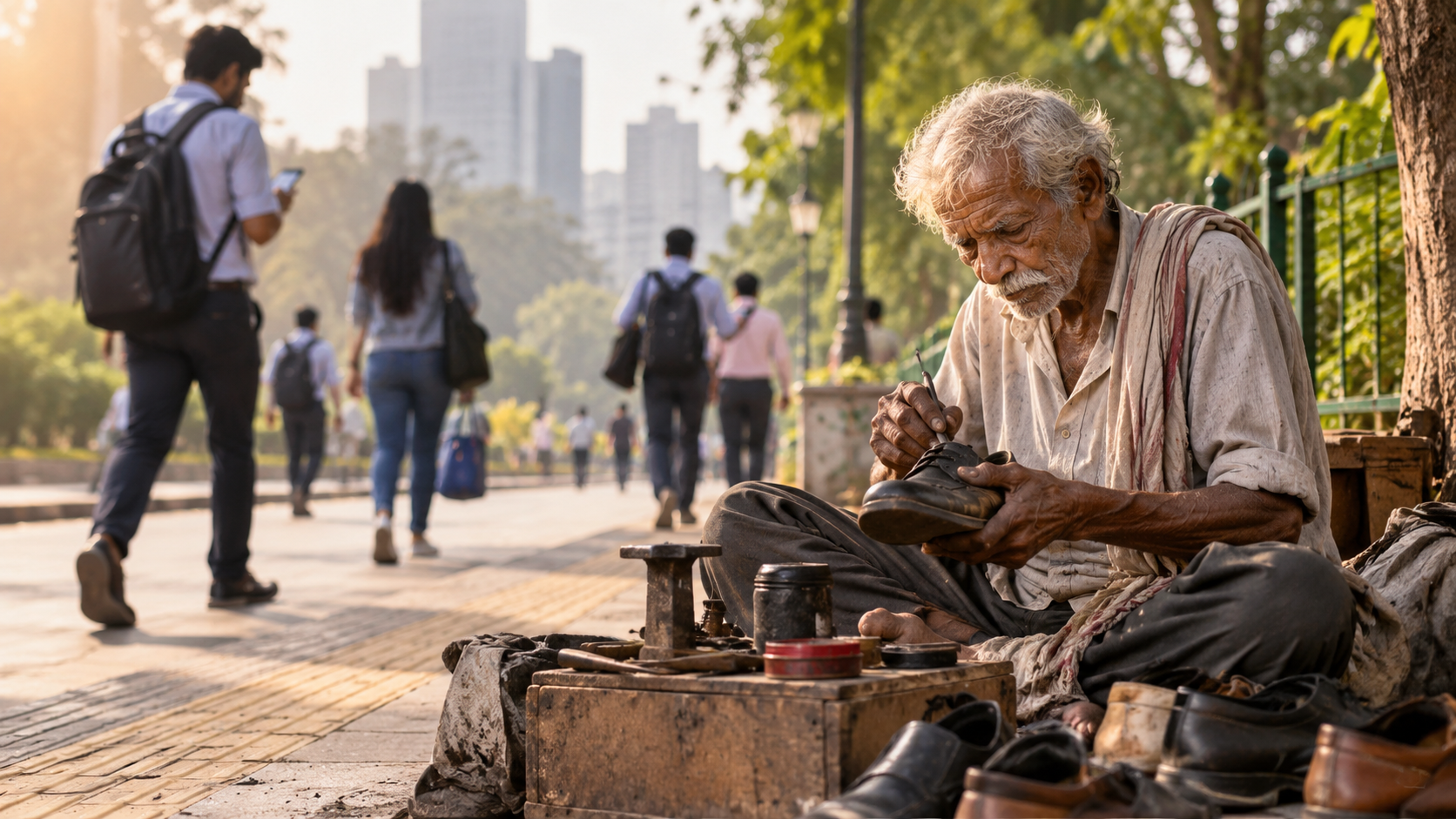
Years back, I had been to North India for some work. Every day, after work was over, I was in the habit of seeing new places in the city. One day, while moving around, my chappal needed immediate repair due to wear and tear. I searched for a cobbler and found one sitting adjacent to a park. I went to him and, to my surprise, found him to be an old man of eighty plus. He did not even wear spectacles while doing the work, most probably because of his long-time habit. I sat by him and tried to talk to him. He was a man of few words. I asked him, “Uncle, you have to work at this age. Do you not have children to look after you?” He remained silent and concentrated on his work. When I repeated my question, he nodded his head and said that he had children. But they were busy with their respective works. The old man did not criticise anybody for his position and tried to avoid answering that he was not looked after by his children and, therefore, he was forced to work at this age. After my repairing work was over, I left the place, paying the old man his fees.
The sight of an eighty-year-plus old man working has left an indelible impression on my mind, and even after so many years, I remember his innocent face and working in an open place, braving the weather. This is not the only case of an old man working. Nor is it confined to a single city or state. It can be seen everywhere. Now let’s try to analyse the reasons and their probable solutions:
1) Breaking up of the joint family—It is seen that the joint family is breaking up with the course of time. In a joint family, grandfather, father and son or sons live together as a single unit. This type of family can be seen in both urban and rural areas, providing utmost care to the elderly members of the family. Grandfather, grandmother, father and mother are looked after by the younger members of the family. But the joint family system is withering away from the scene, thereby creating problems for the elderly people.
The solution lies in the hands of the family members. It is up to them to keep the joint family intact as far as practicable by making adjustments.
2) Growth of the nuclear family—Growth and expansion of the nuclear or single family have made children stay away from their parents and grandparents. Moving to towns and cities for jobs is one of the main reasons for the growth of the nuclear family. Such a development is only natural in the present circumstances. The young generation is now moving even to far-off cities like Mumbai, Hyderabad, Bengaluru and others, thereby creating a distance between them and their parents.
Though it is quite a difficult task under the changed circumstances, the family members can still have a try in the matter.
3) The generation gap—The generation gap denotes an aura of differences between the old and the new generation. Though it is only natural, yet compromises here and there may solve the problem. But in most cases, it is not being possible. The result is that, with differences of opinion, parents and children find it difficult to live together and, therefore, prefer isolation from each other. But it is seen that in certain cases, children respect their parents and pay attention to their thinking and ideology.
The generation gap is more mental and psychological than anything else. Adjustments and compromises may improve the situation.
4) Withering away of family profession—The traditional family profession, both in urban and rural areas, was instrumental in binding the joint family. Since it was the main source of livelihood, male members stayed at home. They did not have to go outside for jobs. But now, even educated members from farming families are rushing to towns and cities for white-collared jobs. This is disintegrating the joint family system.
Interest of the present generation in family profession and the right encouragement and schemes by the government may be a silver lining in the matter.
5) Disinterest in farming—Though farming and agriculture are the mainstay of our economy, it is seen that after independence, the tendency has been a rural-to-urban movement of people. Even educated members from agricultural families, after getting jobs in towns and cities, are not returning to the village. This has told upon the structure of the joint family.
Interest in farming by the new generation in this age of unemployment and the right steps by the government may prove to be a probable solution to the problem.
6) Running to cities for jobs—The attraction of white-collared jobs in towns and cities and a luxurious city life with all kinds of facilities are instrumental in breaking up the joint family system. It is seen that after independence, the ratio of rural-to-urban movement of people has been always on the increase. At the time of independence, the urban population stood at 17 percent of the total, which has risen to 36 to 38 percent as at present. This shows the rural-to-urban movement of people, thereby affecting the joint family system.
Interest in agriculture, allied sectors, family profession and the right steps by the government for the development of rural infrastructure and agriculture may bring about an improvement in the situation.
7) Growth of materialism—Man has become extremely materialistic today. He is more interested in savings and investments than spending on others. Even parents are appearing to be a burden to their children. Since the cost of living and a different lifestyle have become expensive, this is forcing children to stay away from their parents. As, for example, there was no mobile earlier. But now, one has to spend a minimum of Rs 300/- per month.
This again requires adjustments and compromises on the part of the family members.
8) Financial constraint and poverty—Though there has been a downward movement in poverty in our country after independence, yet poverty and financial constraint have been a decisive factor in separating parents from their children. For better financial management in the family, children are preferring to remain single. Children who are keeping their parents with them are not able to look after them properly due to poverty.
This is again a very difficult situation to counter. No doubt, the government is taking various steps for the all-round development of the people, whose economic upliftment is a must.
9) Disrespect for tradition—In India, people have a great respect for tradition and age-old values. But circumstances have forced the young generation to go against the tradition of respect for elderly people like father, mother, grandfather, grandmother and others. Poverty, financial constraint, differences of opinion, a sense of independence and going to far-off places for jobs are the reasons behind this disrespect for tradition.
The problem involves the mentality of the people and requires improvement in it.
10) Self-centred attitude of man—Man has become selfish and self-centred these days. He hardly thinks of others in the midst of his work and selfish interests. As he is so busy pursuing his interests, he does not have time for his parents. In certain cases, parents also become self-centred when they expect too much from their eldest sons with respect to their younger sons and daughters, with which the eldest sons find it difficult to compromise, as they have their own family to look after. It is because of this reason that eldest sons in the family separate first, thereby staying away from their parents.
Man has got to be liberal and large-hearted to take others’ interests into consideration.
11) Sick mentality—At times, it is seen that a sick mentality develops amongst children. When parents become too old, it is a matter of concern for the children as to who will look after them. Nobody wants to take the whole responsibility of care and finance for the elderly people. So they prepare a monthly roster for their old parents to ease their burden. One son will take care this month, while another will take care next month. Is it not a sick mentality when parents have taken so much care in bringing up their children!
Man has to change his mentality to tide over the problem.
12) Self-imposition—In certain cases, it is a matter of self-imposition. Most parents are very much independent-minded and do not want to depend on their children. But it is not possible in extreme old age when they are diseased and even bedridden. Another reason is the disinterest of parents in leaving their ancestral house or the house they have built. So when their children build a new house or go to a far-off place for a job, they stay back. Those parents who have more than one son do manage to retain the younger one with them in the ancestral house.
This again requires a change in mentality, adjustments and compromises amongst the family members, particularly the elderly people.
Senior citizens or elderly people constitute 14 percent of the world population and 12 percent of the Indian population approximately, which are expected to rise to 22 percent and 21 percent, respectively, by the year 2050, as per survey reports. In India, the senior citizens or elderly people constitute about 58 percent women, and widows form a bulk of it. The International Day of Older Persons is celebrated on the 1st of October every year to create awareness amongst the world community regarding old-age issues, age discrimination and the contribution of older people to society. The elderly people have vast experience in life and deserve all the happiness in the world. We must see to it that efforts are made at all levels for taking their proper care.
(The views expressed are the writer’s own)

Mr. Prafulla Kumar Majhi,
Retired Asst. Director, A. I. R, is an eminent Scholar and freelance writer in English & Odia. His areas of interests are sociocultural, economic, literary, historical and analytical studies and writings.
Email: airprafulla61@gmail.com
Mobile.9861007190