

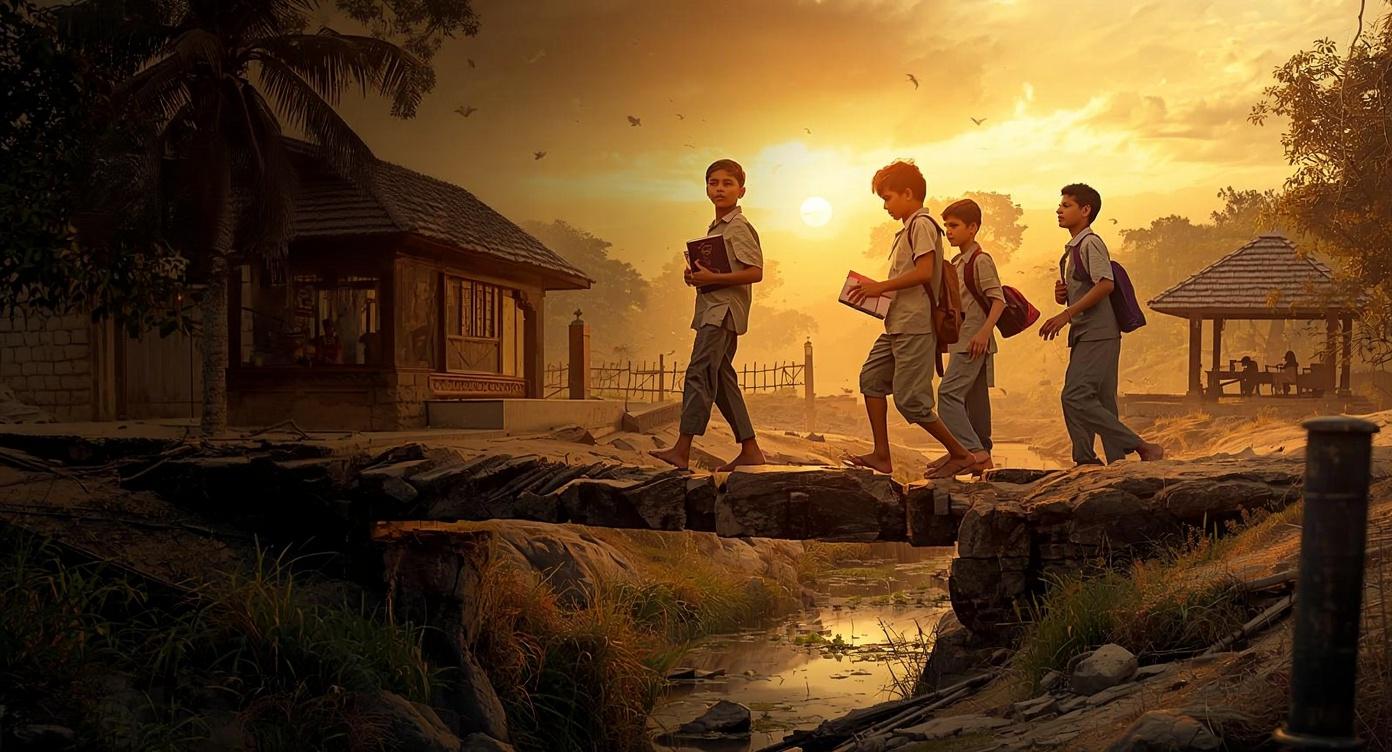
The time dates back to the year 1972 and even earlier. We were then the students of Dhanupali school. Dhanupali was a village and not within the jurisdiction of Sambalpur Municipality. The old bridge of Govindtola had already broken. We called it ‘Bhanga Pulian’ or the broken bridge. Though the bridge was broken in the middle, yet one thick pipe was still there joining one end with the other. Certain courageous boys sat on the pipe and dragged themselves towards the other end for study in Commissioner’s Colony school. Otherwise, they had to cover at least an extra two kilometres in case they went via the new bridge. But we went via the new bridge to go to Zilla school after passing out from fifth standard. The road was desolate except for Charbhati when we crossed the new bridge, or ‘Nua Pulian’, as we called it. We felt very lonely at this place. On occasion, when evening set in while returning from town, we developed a sense of fear. But nothing untoward has ever happened. We called Sambalpur ‘town’ then. Even now the word ‘town’ comes out though Dhanupali has already become part of the city of Sambalpur. The chowk has grown in size. New houses, residential areas, and markets have come up. At that time there were very few houses on Sambalpur, Cuttack, Dhama, and Deogarh/Ranchi Roads. When on holidays we boys came out on summer afternoons, all places appeared to be desolate. Near the chowk we ate ‘murhi’ and ‘chana’ sold by Rambha and Hari. At times we got the same from Sukanti in Sunaripara. There was Ganshu hotel near the Gopaljee temple pond. He prepared very tasty ‘chana’ and ‘aluchap’. The taste of items prepared in the morning continued even up to the evening. He prepared ‘gulgula’ or ‘ata bara’ on occasion. In addition to all this, there were Sahu and Nandy hotels on the chowk.
We have grown up in such a place and environment. There were very few houses and people knew each other. Chandan Yatra was held every year. Sanchar parties came from different places and performed throughout the night. Palias or Bayamanas made a lot of fun. We boys sat and enjoyed it. Ashtaprahari Namayagyan was held every year. Sometimes it was held in Gaonbhitar, while at others near the Gopaljee temple. Kirtan parties came from different villages. Gaudbadi was held every year on the occasion of Phagun Puni or Phalguna Purnima in Gaonbhitar. To watch Gaudbadi there was rush in Gaonbhitar in the evening. ‘Saptah’ was organised in the Gopaljee temple. There were recitations from Bhagawat and Ramayana. We boys rushed to the temple and gathered though we could not understand anything. On occasion, over here, ‘prabhachana sabhas’ were organised. Saints came from Mathura and Vrindavan areas. At that time the pond water was very clean. We bathed in it regularly. Trinath(Trinath Hota), whose house was near the pond, gave us tips on ‘guja’ and ‘sheelam’ dives. ‘Guja’ dive was jumping with head straight into the water, and ‘sheelam’ dive was jumping into the water with head straight and hands over it. We swam up to the Trishul (a pillar in middle of the pond), touched it, and came back without caring for the large tortoises inside the pond. Besides Trinath, there were friends like Santosh and Himanshu and junior friends like Sudhanshu, Anil, Muna, Badri, and Gobinda who belonged to what we called then Bandh Para. Then there were Biju and Raju from the chowk area. There were another Gobinda and another Anil from Deogarh or Ranchi Road. We were on good relations with each other and even played together. We liked the spiritual atmosphere of the Gopaljee temple. At times I accompanied my grandmother. My grandmother and other women shed tears while listening to the recitations though we boys could not make any head and tail of it.
The spiritual atmosphere was always there. At times Danda, Panrapat, Dundun Natia, and Sarmangala came. We sat and enjoyed Danda throughout the night. One person with long curly hair came with Sarmangala. At the end he closed the door of the ‘khatli’ and placed a ‘parat’ below it. After some time the bangles of Devi fell on the ‘parat’ through the door. Women present gave ‘hulahuli’. Along with the spiritual atmosphere sometimes strange incidents took place. Once an ‘Aghori Baba’ came. It was rumoured that he sat on dead bodies and ate its meat. Small circus and opera parties also came and held shows either in the school field or near the temple. Plays were also staged regularly by the Chetana Sanskrutika Anushthan which was quite an achievement at that time when cinema was at its peak, thereby making Dhanupali a cultural centre in Sambalpur.
Such a spiritual and cultural atmosphere exercised a profound influence on us boys. Durga Puja had not yet started then. We boys started Ganesh Puja and Saraswati Puja. Very few Pujas were held on each road. But on Dhama road we continued these Pujas for a long time. Mainly myself and Jitendru Prakash Raiguru(Jiten) used to organise Puja either on our verandah or in front of our house. We brought sarees from our houses and went to Dalaipara to bring ‘jari’ and ‘tamda’ for stage decorations. Prior to this we went to the town and purchased two to three Receipt Books for collection of ‘chanda’. People were happy enough to give ‘chanda’. Jamlia, the priest of the Sunaripara Shiva temple, did our Puja. We immersed the statue after a day or two. Sometimes Bhaja(Bhajamana Biswal), Krushna, Nandlal, Bideshi, and Gopal(Mudgar) joined us. With very small amounts of money we had to complete the Puja. We accepted whatever ‘chanda’ people offered us. At times we had to depend on our home. Seeing our interest our parents did not scold us. On occasion if budget permitted we made arrangements for a mike. At that time a person called Shamu gave mikes on hire. In this way we boys were able to create a ‘puja mahol’ in Dhanupali.
Apart from Puja we were active even during Rathyatra and Bahudayatra. At that time there was a tea store at Govindtola chowk. Tea packets came in wooden boxes. Myself and Jiten(Jitendru Prakash Raiguru) went to the tea store and brought one such box and fitted four wheels below it. We got the wheels from toys being transported from Sonepur area during ‘Pura Uans’ and bound four sticks on the upper side of the box so that it looked like a chariot and then decorated it. We had to bring the statue of Lord Jagannath from the Bus Stand. Then we moved our little chariot in the streets. At about this time the Rathyatra of Gopaljee temple had started and Rajendra Badhei who lived just behind the present Durga Mandap area played a key role in preparation and pulling of the chariot. Then Sarbajanina Durga Puja started in Dhanupali. The time dates back to the year 1974. An artist came from Maneswar-Mirgamunda side with his son. He prepared the Durga statue till midnight and if required throughout the night. We were in High school then. We used to sit and watch the statue being prepared. At that time there was only simple decoration of the stage. There were neither large gates nor light decorations. Since we were only in High school we were not directly involved with the arrangements of Durga Puja. Senior brothers of Chetana Sanskrutika Anushthan took a leading role in organisational matters. We only extended our little help when required.
After years of hard work Dhanupali Durga Puja has reached its peak of decorations and popularity and the increasing rush of people in the Mandap makes us feel proud that if not wholly at least partially we have been instrumental in forwarding the Puja in its early stage. We also feel proud of having been a part of the spiritual and cultural atmosphere of Dhanupali and playing our little role in it.
(The views expressed are the writer’s own)
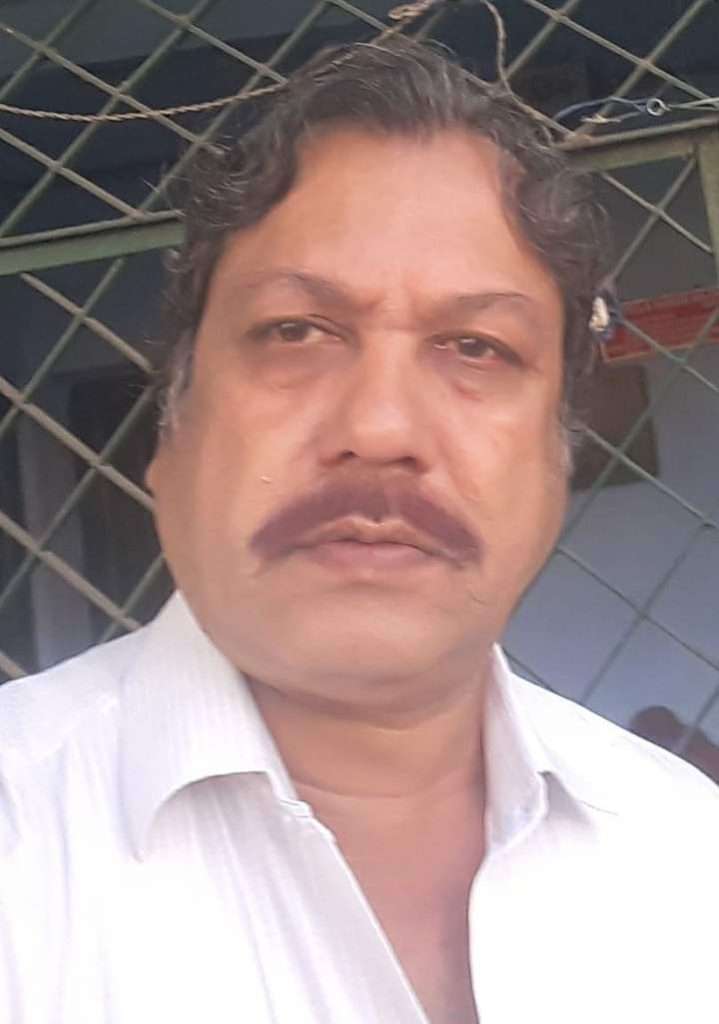
Mr. Prafulla Kumar Majhi,
Retired Asst. Director, A. I. R, is an eminent Scholar and freelance writer in English & Odia. His areas of interests are sociocultural, economic, literary, historical and analytical studies and writings.
Email: airprafulla61@gmail.com
Mobile.9861007190