

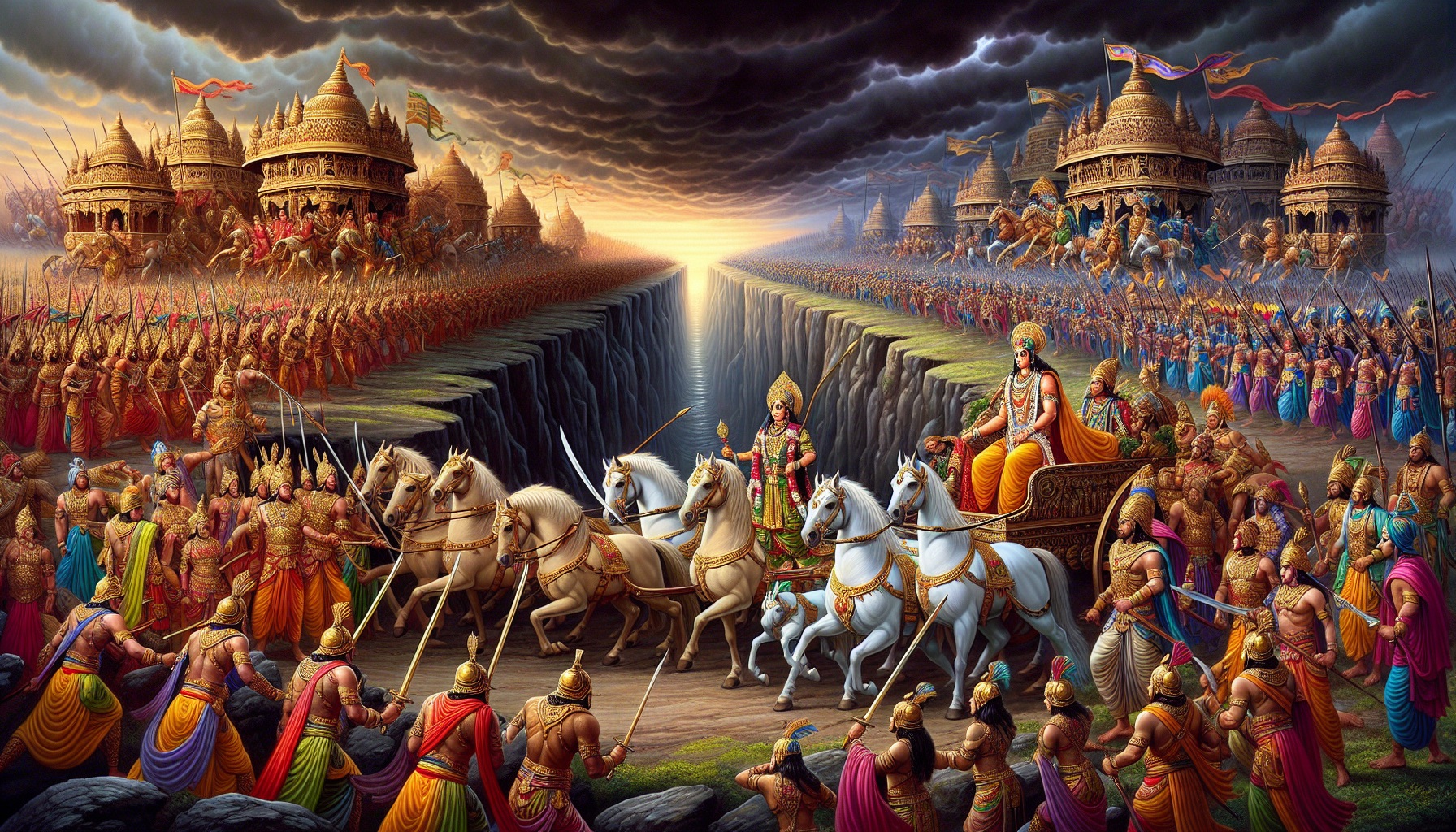
In “Sarala Mahabharata”, on Yudhisthira’s request, Lord Krishna went to Duryodhana to negotiate peace between the Kauravas and their cousin Pandavas, who had a shared childhood, grew up with the same values, and were educated under the same preceptor. He went to his royal court to meet Duryodhana, the Kaurava king. Far from being accorded the traditional courtesies due to an emissary, he faced humiliation in his court. After standing for a long time outside the court waiting to be allowed to enter, he was made to wait a long time before being offered a seat in the court. He told Duryodhana that his kingdom would meet the same fate as Babarapuri.
No one in the court had heard of the city. The wise Bhishma requested Krishna to tell them about the city. No one had heard of the city because Krishna created it and its story in the court itself. That is how I understand the episode in Sarala Mahabharata. Bhandeswara (“the king of cheats”) was the king there, and Baibhanda (roughly, “crazy cheat”), his minister. The naked Andia, whose hair was unkempt, was the presiding deity of the city. It was a city where life was the very opposite of what was regarded as “civilized” in those days.
For instance, works on cheating were respected and read. Cheats and liars were honoured, and the honest were killed. Men and women moved naked in that city, and when they wore something, they wore it to cover only their heads. Sex was uninhibited. People had sex whenever they liked, wherever they liked and with whosoever they liked, unconcerned even about whether they had blood or any social relations with them. It was a very prosperous city. It had no enemies. We will not say anything more about life in the city, because our interest is in its destruction.
One day, all of a sudden, a weird thing happened. A strange voice said that Kokuaa had arrived. In no time, kokuaa fear engulfed the city. People stayed at home, not venturing out even during the daytime. Rumours about Kokuaa spread all over the city. Some said they had seen the terrible creature and that it had seven eyes; others said it had a huge body and its head touched the sky. Some said other frightening things. None had really seen this creature. Unable to bear intense fear and high tension, one day, people came out and fought among themselves on the streets like mad. They started killing, and soon there was no one alive. The city was dead.
“This is the story of Babarapuri”, Krishna told Bhishma in the Kaurava court. Duryodhana’s kingdom was like Babarapuri, he added. The arrogant Kauravas would be destroyed the way Babarapuri was, Krishna said. No enemy from outside would kill them; their arrogance, greed and foolishness would.
What was Krishna’s message? Was the narrative a way of telling the Kauravas what was to come? That is, is that a prediction? In that case, that was destiny. Unalterable. There was no room for human agency. Or, was it a warning? In that case, if the right action is taken, the result would be different; if Duryodhana accommodated the Pandavas’ demand, then the consequences for Hastinapura would not be the same as for Babarapuri. Between the prediction and the warning interpretations, which would be the correct meaning of what Krishna had said? The meaning of his act, namely, telling the story, was his message. Now, to arrive at the meaning of what the speaker said, it is necessary to know his intention. To fathom the intention of ordinary mortals in an act of communication is impossible, be it verbal or non-verbal. But we need to do it, and what we end up with is an assumption, and with that, we try to make sense of the speaker’s utterance. But Krishna’s case is different. Inscrutable are his words and doings, as goes the ancient wisdom. So, we are not inclined to engage in the futile attempt to work out the Avatara’s intentions. In our opinion, between the two meanings, the “prediction” meaning would be the correct one, taking into account Krishna’s Avataric purpose as conceptualised in the Sarala Mahabharata.
If Krishna was telling Duryodhana and his court about what was to come, it made absolutely no impact on King Duryodhana and his brothers. If he was telling them that the worst could be averted if they changed their attitude towards the Pandavas and treated them as their own cousins, and were ready to help them live in dignity. Duryodhana seemed to have read Krishna’s words in this sense, that is, as a warning. He responded to Krishna’s words that his kingdom was like Babarapuri by asking him why he had come. Let us leave the matter of Krishna and Duryodhana here.
The story can be read as an explication of fear. Fear to be experienced needs an “expression” in some form, material or non-material. Kokua was just that. Its source was unknown, and it was not a physical entity; if it were so, the description of its physical features would not have varied so much. Kokua was an individual mental construction. The conflicting descriptions intensified the individual and the collective fear. Frenzied fear gives rise to great tension, and overwhelming fear thrives in such tension. This is what could be a reasonable description of what happened in Babarapuri. Unable to bear the consuming tension, as the people of the city came out of their homes and talked, each differing from the other, there would have been the clash of ego, which, in the fitting condition created by fear and tension, expressed itself in violent action.
As mentioned above, sex was uninhibited in Babarapuri. The partner could be anybody. The urge satisfied, they left – went their own way. Under such a situation, there would be a population, but no parivar (family), so no kula (lineage). Where there is no family and no lineage, there is no tender relationship of bonding, caring, nurturing, protecting, concern and affection. A loveless population, where the world of an individual is the individual himself, is bound to perish under its own weight.
If those who belong to a family and have a lineage refuse to honour kula dharma (family commitments), like Duryodhana, who was unwilling to help his cousins to live a life of dignity after they had suffered for a long twelve years in the forest, would perish. Through the story of Babarapuri, was Krishna telling Duryodhana this, as well?
(The views expressed are the writer’s own)

Prof. B.N.Patnaik
Retd. Professor of Linguistics and English, IIT Kanpur
Email: bn.patnaik@gmail.com
(Images from the net)